
The First Shakespeare Play King John was Written & Published Before William Shakspere of Stratford had Arrived in London: Francis Bacon & the Troublesome Reign of King John (1591)

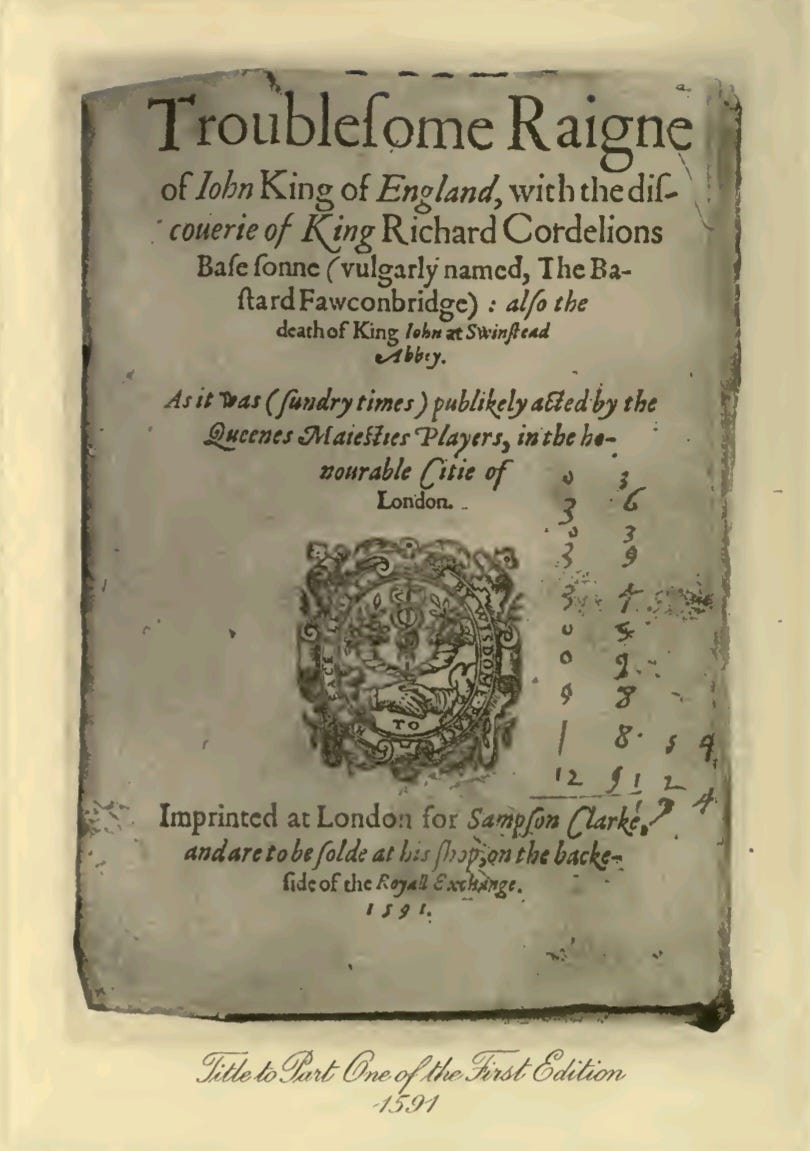
The First Shakespeare Play King John was Written & Published Before William Shakspere of Stratford had Arrived in London. Francis Bacon & the Troublesome Reign of King John (1591)
By A Phoenix
This in-depth scholarly work puts forth that The Troublesome Raigne of John, King of England (1591)—anonymously published and later attributed to "W. Sh" and "William Shakespeare"—was in fact the first Shakespeare play and predates William Shakspere of Stratford’s arrival in London. The author asserts that the true playwright was Francis Bacon, not Shakspere, and that the Troublesome Raigne was the original version of the Life and Death of King John, which was later revised for the First Folio.
---
Key Arguments and Themes:
1. Authorship and Dating
The anonymous Troublesome Raigne (1591) is considered by traditional scholars a source for King John, yet A. Phoenix argues the reverse: the 1591 play is the original, making it the first printed Shakespeare play, predating Venus and Adonis (1593) and Titus Andronicus (1594).
The play is attributed to Francis Bacon using multiple lines of evidence including legal knowledge, thematic depth, character construction, and cryptographic elements.
2. Francis Bacon’s Allegorical Insertion
The central character, Philip the Bastard (Faulconbridge), is shown to be a dramatic self-portrait of Bacon, who was the secret royal son of Queen Elizabeth I and the Earl of Leicester.
The name “Faulconbridge” contains a ciphered anagram: F. Bacon.
Bacon’s secret royal status is reflected in Philip’s dual identity as both bastard and potential rightful heir to the English crown.
3. Legal and Political Subtext
The play explores themes of legitimacy, identity, succession, inheritance, and justice—all central concerns in both the Tudor monarchy and Bacon’s life.
The Bastard’s courtroom scene dramatizes a legal dispute over inheritance, mirroring real Tudor succession tensions and the law of bastardy.
Legal terminology and reasoning throughout the play (e.g., "borrowed majesty", “half-face of justice”) show deep knowledge of Elizabethan law, echoing Bacon’s legal writings and historical works, especially The History of Henry VII.
4. Historical and Political Allegory
The work portrays King John as an illegitimate monarch, paralleling Queen Elizabeth’s ambiguous status and Bacon’s own secret claim to royal blood.
Other historical characters (e.g., the Earl of Essex) are analogs for real figures in Bacon’s life, such as his brother Robert Devereux.
5. Linguistic and Stylistic Parallels
The essay identifies shared metaphors, legal idioms, and rare words between King John and Bacon’s acknowledged writings.
Specific phrases like “half-faced groat” and “sweet poison for the age’s tooth” are analyzed for hidden Baconian references and philosophical depth.
6. Freemasonic and Cipher Evidence
A soliloquy by the Bastard contains a hidden acrostic “F. BACON” using the initial letters and symbolic positioning of words.
Bacon’s known interest in ciphers, secrecy, and symbolic language supports this as intentional authorship marking.
7. Religious and Political Boldness
King John’s opposition to the Pope and rejection of ecclesiastical authority reflects Bacon’s and Elizabeth’s tensions with Rome.
Legal terms like “interrogatories,” “tithes,” and “excommunication” reinforce Bacon’s authorship due to his familiarity with such procedures in State trials.
---
Conclusion:
The article makes a compelling case that The Troublesome Raigne—and thus King John—was the earliest of the Shakespeare plays and penned not by the man from Stratford, but by Francis Bacon, embedding in it his own secret identity, political critique, and philosophical vision. The work draws from a deep well of textual analysis, legal commentary, cryptographic interpretation, and biographical insight.
&
7.5.2025: A 400 Year Secret: A Bacon-Shakespeare Ludibrium