
Robert A. Millikan
A Natural Philosopher

Robert A. Millikan
A Natural Philosopher
by Alvin Boyd Kuhn
* Electronically typed and edited by Juan Schoch for educational research purposes from New Outlook, circa 1954. This notice is not to be removed.
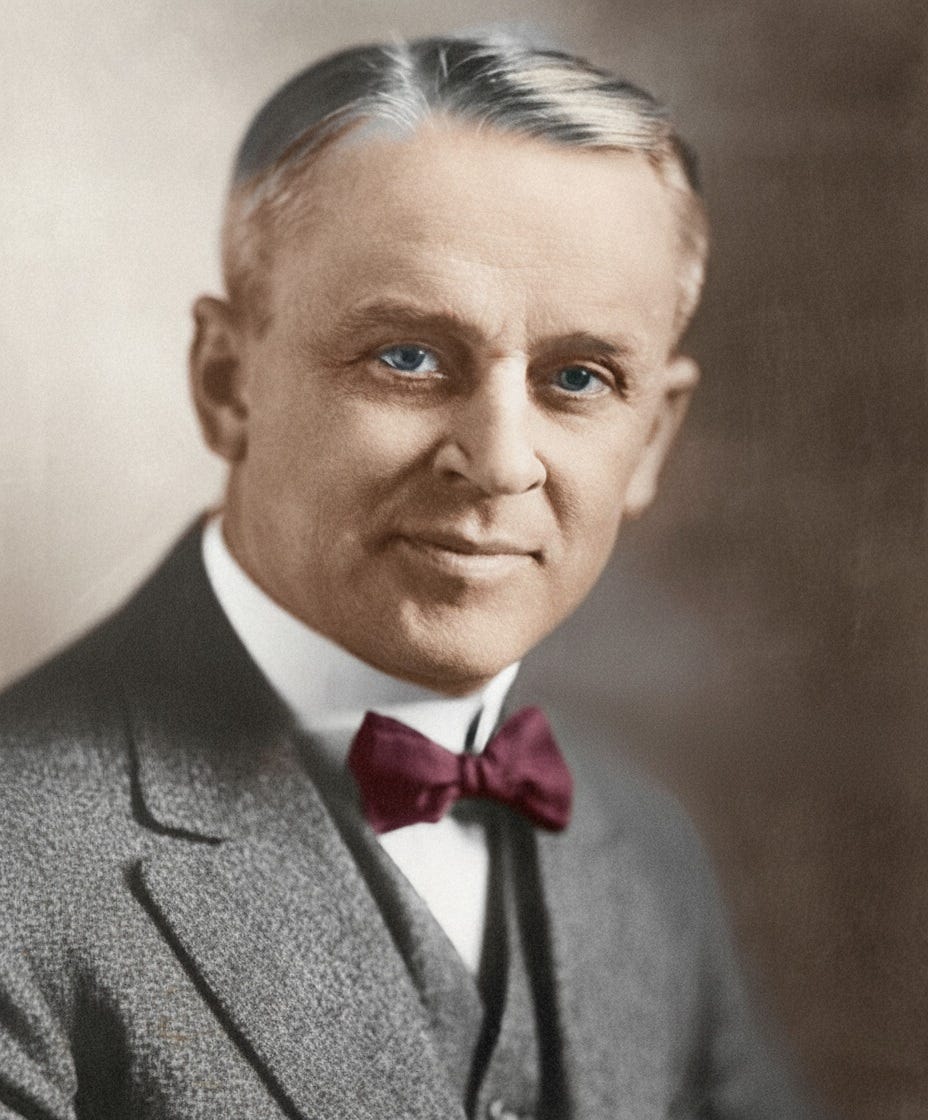
It so often happens that the world does not wake up to the realization of the greatness of one of its citizens until his passing makes us suddenly aware of our loss. Famed, yes, and highly honored was Dr. Robert A. Millikan while in the flesh with us. But it is not likely that the true measure of his greatness was appreciated outside perhaps the smaller inner circle of those who may have lived in close fellowship with him. Even in that circle his finer qualities may have been taken for granted and not recognized as the clear marks of exceptional strength of character and rare fineness of soul. His extraordinary career of achievement challenges us to look more closely into the elements of his nature and assess them as eminently worthy of admiration and possible imitation.
There have been and doubtless always will be individuals who attain eminence and world recognition by the display of great genius in one specialty or in a limited range of effort. It seems, however, that those fewer ones who have mounted or been elevated to the very highest pinnacle of world homage in history— outside, of course, of the circle of purely military conquerors like Alexander, Caesar, Napoleon, Hannibal—have been individuals who were, one might say, ecumenically great. That is, they achieved greatness in many seemingly widely separated fields, and in fact manifested their greatness by being able to discern, bring together and unify in a consummate synthesis the elements of insight and knowledge in many departments of life. It is all too true, as St. Paul reminded us, that under its evolutionary handicap of initial ignorance the human faculty of intelligence is only able to see things singly, in part, detached from proper relation to the context of whole reality. One may be great as a specialist, but it takes extraordinary capability to rise above specialization. And the tragedy in this is only discussed when we realize, as we must, that the evolutionary task in our advance toward godhood demands that we see all things in their basic unity.
The Greek philosophers in particular pointed out the necessity of seeing things whole. It is close to certainty that the prime—and sublime—function of the great science of philosophy (rated in Plato's day as the Kingly Science) is to bring the genius of man to an understanding of life and the universe as an integer, with all aspects of the reality interrelated harmoniously in a magnificent organic unity. This is the conclusion reached by Aristotle, Plotinus, Spinoza and Kant, by philosophical reflection in general. Kant's great phrase, which summed up his systematic dialect, was “the synthetic unity of apperception.”
It is interesting to recall that some ten years ago it was the dream of Dr. James B. Conant, President of Harvard University, to institute a new order of instruction at the advanced university level, by appointing what he called “roving professors.” These were to be men of such breadth of education and knowledge that they could go from one department to another and correlate the material of each with that of others, building bridges of interrelationship between all. Doubtless the practical difficulties were found to be insurmountable and the scarcity of teachers so qualified must have been a deterrent. But the idea must be admitted to have a solid basis in the obvious need of coordination in education. Even psychology in its latest modern development asserts that from every pragmatic angle of approach the full balanced life in consciousness demands the utmost possible integration of knowledge elements.
The ancient Scriptures adjure us with all our getting, to get understanding. And understanding is itself just the integration of component elements in a rational synthesis. Both by the golden wisdom of the sacred Books and by modern pragmatic science such integration is declared to be the prime and indispensable basis of health and happiness. “Integration of the elements of the psyche” may be said to be the golden text of modern psychiatry. The eminent psychologist Jung has in effect said that the basic failure in our Western life today is the dearth of knowledge of meaning and purpose in life, due to the breakdown of philosophy.
In its report of Dr. Millikan’s recent death the New York Times extolled his greatness as follows: “Millikan possessed that rare combination found only in the great among scientists—the practical-mindedness of the research scientist and the imagination of the poet. In him were harmoniously blended the faith of the mystic and the skepticism of the empiricist. Religion and science were to him not contradictions, but complementary faculties of human nature. A true love and understanding of nature meant to him also a love and understanding of man and of God.”
This, be it asserted, must be admitted to be the basis of the evidence of a man’s exalted status that we call greatness. A genius that can bridge the vast gulf in ordinary thought between the work, aims and interests of empirical science and the sublimated affiliations in the impalpable realm of mystical experience must be one of exceptional power. Ordinarily these two fields of human interest are nearly poles apart. The mind that can bring them together in a unity of interdependence must be one of both depth of penetration and breadth of view.
Fundamentally, of course, the accomplishment demands the power of envisioning the fundamental relationship between the human body and the divine soul in man’s composite nature. As such an achievement, it constitutes the basic situation and sets the ground problem in both religion and philosophy, in ethics and psychology as well. If the conditions indispensable for the proper and salutary relationship between body and its psyche are known, then science, which must be considered primarily concerned with the interests of the body, can be adjusted to its beneficent service to the interests of the psyche, in the field of religion. Knowledge of the essential interdependence of soul and body at once opens the vision of community of interest as between science and religion.
The very late incidence of psychosomatic medicine attests the final recognition of this problem of soul-and-body interdependence. Hitherto science has worked for the discovery of things utilizable by and for the body, with little regard for their influence, on the psyche. Conversely, religion has striven for the phenomenalistic exploitation of psychic incitements without regard to the body as incidental to or affected by them. The transcendent problem of philosophy is to chart and cultivate the midground of experience on which the two meet and exchange influence to yield a common product,—the product of growth in life.
Those who have been acclaimed the greatest in history’s scrolls were almost always characters manifesting an ability to sum up in final wisdom a wide range of interest and knowledge. Based on extensive versatility, their consummate views embraced universality. They touched life closely, both exteriorally and interiorally. To a greater degree than generally they sensed always an indissoluble kinship between—as Emerson puts it—“the inner spirit and the outer matter,” and they thus stood “as priests and interpreters of nature thereby.” So it is highly significant that the Times said of Millikan that a true love and understanding of nature constituted the foundation of his love and understanding of both man and God. Science has kept its service limited in ultimate beneficence by failure to relate its contribution to man’s enlightened understanding of his relation to God. Religion has lessened the impact of its service by failure to take in the indispensable offices of nature and the body. And human genius has so far failed in its given task of correlating both interests in full harmony, either in understanding or in practice. This gigantic task now confronts the developing potential in human intelligence.
Of old, the science of analogy between the life in consciousness and the life in nature was of paramount and central importance and utility. Life in all its facets, both inward and outward, was seen as an integer. The material fact, object or phenomenon was seen as the visible front of an invisible reality behind it. Nature was the visible garment of the unseen veritude. As Hermes had expressed it, “True without falsehood, certain and most true, that which is above is as that which is below, and that which is below is as that which is above, for the perfection of the operation of the One thing.”
The heart and the periphery of life are but two nodes of the One Thing. The periphery is the heart manifested on its visible surface. Aristotle saw this, the Medieval occultists worked on its principles. Paracelsus, Raymond Lully, Thomas Vaughan, the two Bacons, Roger and Francis; Giordano Bruno, the great Leonardo da Vinci; the Renaissance philosophers to a degree; and down in our own time Thoreau, Emerson, Drummond, Swedenborg, philosophically; Franklin and more notably Jefferson; in a certain less pronounced sense even our Edison, Burbank, Burroughs and Henry Ford. With heads high amongst the clouds of the mystical intimations of human thought, these men also had their feet firmly planted on the ground of natural fact and were sensitive to natural influence. It is not insignificant that in college curricula even 50 years ago the subject of physics used to be denominated “natural philosophy.”
Yes, nature has a philosophy and its apprehension by the human mind acquaints that mind with the rudiments of the philosophy of all life in the cosmos, as well as that of man’s animal psyche as of his immortal spirit. Robert A. Millikan is now revealed as one of those who described the majesty of God in the work of His hands, and saw that the soul of man was the conscious counterpart of visible nature.