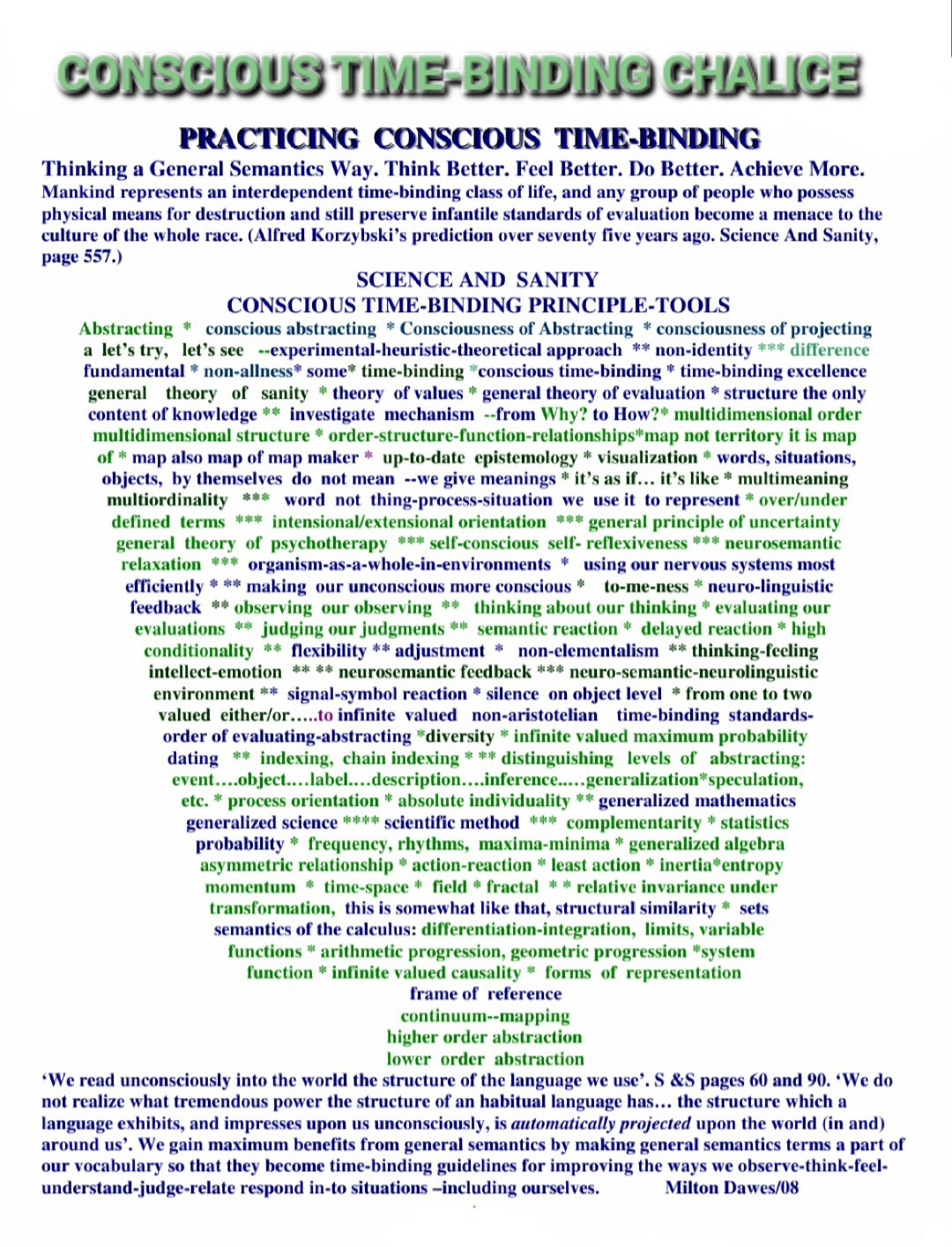
Practicing Conscious Time-Binding

Practicing Conscious Time-Binding
| Milton Dawes/Revised "chalice" 9.18.2010
General Semantics: A theory of values and evaluation. A theory of sanity. A theory of psychotherapy. A general theory of time-binding. An extensional discipline comprising a set of inter-related principles-generalizations of the methods and approach of science and mathematics as principles-tools for general improvement and progress; principles we can use as evaluating standards and time-binding tools to help us avoid or minimize the harmful power of language, symbols, images, etc., so we can use them toward general improvement and sanity in our human affairs and in our relationships.
A way to improve ourselves—our thinking, attitudes, relationships, and behavior
From noun to verbs: When as student-practitioners of general semantics we treat and identify, “time-binding” only as Korzybski’s definition and classification of human beings, we miss opportunities to think of time-binding as an activity, a behavior, something we do. When we think of time-binding and other general semantics principles mainly as labels and nouns and not as verbs, we are more likely to talk, write about, ‘analyze them to pieces’ than apply them to our life situations and use them as psychological tools we can use for improvements in all areas of our living.
In verbalizing, we are in keeping with a scientific approach in emphasizing operational, functional, actional language. Keeping in mind that general semantics was formulated as a discipline, I think student-practitioners could discover deeper aspects of the system and benefit tremendously by using a little ingenuity in creating their own verbal forms for general semantics principles. With a little contemplating, readers might recognize that in terms of change and process, verbs more accurately describe, and more accurately represent a world of activities and happenings. Our nouns and labels ‘influence’ us—often to our disadvantage—to identify, forget, and treat ourselves, others, things, situations, societies, etc., as unchanging.
One way to verbalize the principles: Make sure you understand what the principle is about—visualize the behavior (operation, activity, etc.) represented by the principle; create a related verb. For example: The principle of non-identity ‘says’ “No two things are the same in all respects—and a ‘thing-ing’ (in terms of time, process, change) is not even identical with itself.” We can verbalize this to: “dis-identify”—notice differences between things, situations, etc. that seem the same”. The principle of “non-allness” ‘says’ “We cannot sense, know, understand say, etc., all about anything.” Verbalize to: “Remember” whatever my experience, whatever my plan, action, decision, etc., I have left out many factors. The principle of nonadditivity: More and more of a good thing might make matters worse; going faster and faster might not get us there sooner and sooner; more and more light does not make us see better and better but could be blinding. Verbalization: “Remembering” value shift could be advantageous.” (These are my verbalizations. I think you will benefit more from experiencing making up your own.) If you find a particular principle difficult to verbalize, link the principle to the activities represented by the verbs “remember”, “notice”, and “be aware of”.
Let’s apply this verbalizing to “consciousness of abstracting”—a label for a foundational principle of general semantics. General Semantics ‘emphasizes’ training ourselves to develop “consciousness of abstracting”—conscious awareness of our abstracting behavior—“remembering” that in our abstracting we have not included all. Starting with “abstracting”: In the discipline of general semantics the term “abstracting” covers all our neurological and psychobiological activities. Neural circuits interacting can be described in terms of activating, regulating, reinforcing, inhibiting, summarizing, integrating, and so on. In our daily interactions we attend to, notice, etc., certain things and we leave out, ignore, reject, and forget others. “Abstracting” (attending to, leaving out, etc.,) labels something we do at psychological levels without necessarily being consciously aware that we do this. We do not usually treat, or think of “consciousness” or “awareness” as verbs—representing behaviors—something we do. But we can be “conscious of”, we can “catch” ourselves, we can “notice”, “attend to”, ignore, etc., what we are thinking, saying, feeling, doing, noticing, not noticing, and so on. If you say to me “be conscious of what you are doing”. I interpret this as a suggestion that I “behave”-modulate my behavior in a particular way. Consciousness of abstracting involves noticing, attending to, recognizing, remembering that in our thinking, feeling, doing, etc.—in our abstracting, we have included some things, and selected, left out, ignored, forgotten others. We have not included all. The phrase “consciousness of abstracting” as it relates to modulating our behaving in a particular way, can be thought of as both verb—something we can train ourselves to do—and as adverb—a way to modify whatever we are doing. (See “A Grammar of Consciousness”, and “Structuring”.)
On time-binding: Alfred Korzybski was appalled by what he saw humans doing to other humans during his service at the front in the First World War. He created his system “general semantics” after many years of research motivated by a deep curiosity. He wondered how we humans could be so technologically advanced yet continue to behave in such primitive ways towards each other. [Ed. note by JVS/pc93/timebinder: As stated Count Alfred was deeply affected by the horror of human behavior during WWI; he was profoundly disturbed by the scale of destruction, irrationality, and suffering he witnessed. He saw how humans, despite their capacity for reason, engaged in self-destructive and violent behavior. This experience motivated him to understand the underlying causes of such irrationality and to develop tools to prevent future conflicts.] After many years of research he came to an understanding of the mechanism behind our technological advances: Technology arose from a sense of utility, human creativity and inventiveness, and progressed from the applications of the findings of scientific and mathematics activities. He recognized that advances in these two fields depended mainly on practitioners in the fields in communicating with others. And in communicating, they were constantly copying, reviewing, redefining, revising, expanding, and seeking to improve earlier ideas, theories and practice, in the light of new information and experiences. In science, refinements and improvements resulted from (through observing, conjecturing, visualizing, experimenting, and theorizing), seeking better and better match- ‘maps’, explanations, and theories, based on observations in the territories they were supposed to be maps of. In the case of mathematics improvements came from the application of rigorous thinking–more and more refined discriminations. Korzybski evaluated this combined approach as representing exemplary models, excellent examples of our human time-binding abilities in practice. He evaluated these methods and approach as time-binding behaviors worth studying and copying.
Time-binding theory: Korzybski considered science and mathematics activities involving human thinking at its best—best in terms of predictability. He proposed that if we studied and applied these methods—time-binding behaviors formulated as general semantics principles: we would improve the way we think-feel about things; we would improve the way we relate with each other and with ourselves, and enjoy more satisfying relationships; we would improve our interpersonal, national, and international relationships; we would develop ourselves towards improving levels of critical-creative thinking; we would experience less conflicts within ourselves and with others; we would use our nervous systems more efficiently and feel less stressed. Korzybski theorized that if we copied the time-binding methods of science and mathematics we could achieve through improved evaluating, a measure of success and progress in all areas of our lives, comparable to the achievements in science and mathematics. And most importantly, he theorized we could create a more peaceful and saner world since in our everyday thinking, behaving, and relating, we mainly mindlessly follow and less critically evaluated, our values, beliefs, ideas, attitudes and approaches.
We time-bind naturally—but we are not usually aware of this. When we act simply in terms of our natural time-binding abilities, we improve what we do—including the harmful things we do to ourselves and to others. (Developing better techniques to destroy millions of other time-binders in gas chambers comes to mind.) Conscious time-binding involves our becoming aware of this natural behavior, and developing a sense of interdependence, responsibility, and concern in acknowledging that, and how we receive from others and ourselves, and what and how we pass on to others and ourselves. In conscious time-binding, we learn from our mistakes instead of making up excuses and blaming—a time-binding way to expand and improve our intelligence and behavior.
From his research in the fields of science, mathematics, and psychiatry (he saw in psychiatry examples of human thinking at its worst), Korzybski formulated his findings and proposals in his books “Manhood of Humanity[: the Science and Art of Human Engineering]” and “Science and Sanity” and called his system “General Semantics”. As a set of interrelated principles, general semantics as a system-discipline, constitutes a general theory of sanity, a general theory of psychotherapy, a theory of values, a general theory of evaluation; an up-to-date epistemology; a generalization of the methods and approach of science and mathematics as excellent examples of our human time-binding abilities in practice; and a set of psychological tools (principles) we could use for general improvement and progress in any area of human interactivity.
Practicing time-binding (conscious time-binding): In practicing conscious time-binding, we consciously, deliberately, use general semantics principles as standards against which we match and modulate our sensing, thinking, feelings, beliefs, understandings, knowledge, attitudes, utterances, and behaviors. Embedded as we are in a mainly non-conscious time-binding world, this is not an easy task. But to the extent we practice conscious time-binding, not anxiously, not stressfully, but playfully, intelligently, and with ingenuity, we approach what I understand Korzybski to ‘mean’ by “time-binding excellence”. (See his “Manhood of Humanity”, pages 73, 194.)
Time-binding is Korzybski’s label for a behavior that incorporates a heuristic approach. We learn from ourselves and from others. We learn from mistakes and accomplishments. We learn how to improve our learning. (I call learning and improving with regards to oneself “intrapersonal time-binding”.) With a heuristic approach we modulate our ability as individuals to create new things; improve on our creation; and through symbols, language, images, drawings, paintings, songs, plays, etc., pass on information for others to carry on. So in principle, one generation can start from where the former left off, improve on this, and pass on both their improvements and mistakes to others to learn from and do better. Language, symbols etc., facilitate and speed up time-binding, but time-binding does not necessarily depend on language and symbols. We can learn and improve from looking, listening, touching, and from a ‘mere’ look or gesture. Even little children time-bind in terms of negative (disapproving) and positive (rewarding) feedback. We facilitate time-binding by thinking in terms of multimeaning. In this orientation we evaluate experiences, words, things, situations, etc., as semantic variables. Remembering multi-meaning allows us to minimize our tendency to give one meaning, and motivates us to look for and appreciate other possible meanings, significance and values. We are time-binding by simply reviewing and reformulating something we said or wrote.
Conscious time-binding complements gut feelings, intuitions, dreams, trial and error, guesswork, etc., with specific general semantics time-binding improvement principles—the generalizations of science and mathematics approach. In conscious time-binding we become aware that we abstract from abstractions, and we time-bind from our own time-bindings, and those of others, modulated by a consciousness of abstracting, and other general semantics principles.
Applying a calculus approach: Practicing time-binding starts with conscious awareness. We cannot mindfully change, stop, modify what we are ‘doing’ if we are not aware that we are doing, and what and how we are doing. Practicing conscious time-binding involves being motivated: to develop skills in clearer thinking; to watch the way we use words and how words use us; to be inventive (not necessarily in the commercial sense); to excel; to do something different playfully and/or with gravitas; to exercise our curiosity; to do better; to make things work better, stronger, last longer, go faster, go slower, lighter, heavier; to do something more efficiently, effectively, with more expertise, and so on.
An example of conscious time-binding is suggested in the following self-conscious self-reflexive conversation starting with these questions: What am I aiming for? What am I trying to achieve? Is it achievable? Am I being realistic? What’s my goal? Have I stated my goal clearly—clearly enough to allow me to assess my progress or recognize when I have achieved what I set out to accomplish? What are my plans? Are my expectations reasonable? How do I start? How am I doing? Am I am moving away from or towards my goal? How can I do better? What does “better” involve? How else could I approach, think about, do this? Has this been done before? Is this something new? What can I learn from the mistakes and success of others? What can I bring from other seemingly unrelated areas to this? What can I use, try, apply, etc. from others, or from my own past experiences? What resources do I need—time, space, money, energy, expert advice, help, and so on? How can I assess my progress? What do I mean by “progress”? A broad range of general knowledge and a wide range of interests help us in becoming more conscious time-binders by expanding the pool of general information for us to draw from and improve on. (At societal levels, time-binding (not necessarily conscious time-binding) is accelerated by the maieutic clash of ideas, and exposure to new and unfamiliar ideas resulting from the interactions of immigrants from many cultures.)
Blocks to time-binding and conscious time-binding: In our societies, and in many political, religious and other belief systems, time-binding is suppressed through sublimation, education (learn—usually not learn and try to improve), persuasion, propaganda, group pressure, ridicule, threats, and sometimes force, as ways to discourage freedom of thinking, speech and action. ‘Cultures’ (as expressed in groups, organizations, societies, etc.) maintain a certain order in the conditioning, training, and rewarding of its members not to be too critical, but to do things the traditional, the usual, and ‘culturally’ accepted ways. We are expected to be patriotic: “My country good or bad—right or wrong”. We are expected to support and be loyal to the groups or ‘parties’ we belong to no matter what. We tend to behave in ‘allness’, one-valued, and two-valued ways—“this can only mean that”; “that’s all there is to the matter”; “the important thing is”; “it’s because”; “the only reason”; “it should be, it ought to work, happen this way”, and so on. When we think our beliefs, opinions, explanations, etc., are more important than what’s going on, we block our time-binding activities. When we are afraid to look different, to do things differently; more concerned to “play it safe”—don’t take chances; afraid to be ridiculed, called names (idealist, visionary, etc.); afraid to be thrown out of the group, these fears and concerns can diminish our time-binding impulse and our courage to try something new and different.
We suppress our time-binding abilities when we feel reluctant to ask questions for fear of being judged ignorant or laughed at. In a mode of low self-esteem, when we distrust our own thinking, and have a low level of confidence in our own ideas and imaginings, we inhibit our time-binding behavior. Time-binding is also suppressed by an inflated ego, an attitude sometimes expressed in words to the effect “I am the expert. What do you know?” We squelch time-binding when we take too seriously our roles, ranks, status, titles, positions, time-binding achievements, etc., and find it difficult to listen to others, learn from, or give the appearance that we could learn from them. We suppress time-binding when we ask “Why?” and feel satisfied with one answer, rather than being interested in exploring mechanisms and finding out how things work. Conflicts of interest block time-binding both at conscious and non-conscious levels. Uncritically held personal values, opinions and beliefs make it difficult to accept other points of viewing.
We restrain our time-binding behavior when we fear making a mistake and cautiously stick to familiar ways; when we are ready to make up excuses, and cannot admit to a mistake or ‘error in judgment’; when we feel anxious that we might fail; afraid that we might not get it “right”. When we behave narrow-mindedly in a “know it all” stance—refusing to face facts, determined to save face; and being so sure and confident that we have the right and best ideas, answers, opinions, explanations etc., that we dismiss those of others, we quell time-binding. We block our time-binding when we neglect our critical and creative abilities and refuse to look at the bigger picture, the longer cycle, and explore underlying causes and interrelationships by looking for contributing factors to a problem or challenging situation. Chronic (long duration and frequently recurring) stress damages brain cells, affects learning and memory and inhibits time-binding; so do unexamined assumptions, unquestioned answers, and jumping to conclusions based on hasty and untested generalizations.
As you might have noticed, there are many blocks to time-binding. From my own experience I am very well aware that practicing conscious time-binding is not easy. There are blocks due to psychodynamic and psychobiological (mental, emotional, behavioral) disorders. Many if not most time-binding blocks are activated automatically and usually non-consciously. Prejudice (stereotyping and prejudging someone, some group, some situation and so on) does not help us to develop time-binding skills. Ironically, we can develop great skills in our time-binding blocking behaviors. Minimizing time-binding blocking requires constant vigilance and much practice in self-conscious awareness. We can become more conscious time-binders and make improvements faster when we strive to recognize our individual, societal, cultural, and national time-binding semantic blocks. We practice general semantics in practicing conscious time-binding. Good practice requires more than attending a few seminars and reading a number of books. It involves a lifetime of learning and unlearning habitual ways of sensing, thinking, evaluating and reacting.
Time-binding from time-bindings: The term “abstracting” involves our sensing (seeing, hearing, smelling etc.); our remembering, thinking-feeling, believing, judging, wondering, imagining, fearing, planning, deciding, following, leading, explaining, concluding, talking, singing, writing, drawing, sculpting, building, and anything we do. We usually abstract from abstractions, time-bind from time-bindings, not to do worse but to do better. We might not succeed in this—but we rarely do things to succeed in doing worse. And even when, as in “awful stories” contests, we succeed in doing worse (at one level of abstracting), at another level we have done better than the earlier ‘worse’ attempts.
Some benefits from practicing conscious time-binding involves:
* Complementing what we have learned from books and articles, with knowledge gained through our own life experiences and practice, and “laughter”: Seeing the humorous sides of things as a gentle way to open us to other points of viewing, and other possibilities.
* Developing sensory awareness in noticing the way we look, listen, etc. In terms of grammar-and-awareness; think of “observing, sensing, looking”, and so on, as “behavioral verbs”; the way, the how we look at things as “behavioral adverbs”; and what we see, hear, etc., as ‘objects’. When we become aware of “how” we look, listen, speak, write, explain things, make plans and come to decisions, etc., (treating these behaviors as ‘objects’ we attend to) in such self-reflexive activity we develop the ability to become better observers, better listeners, speakers, writers, better planners, better decision makers and so on. As better observers, listeners, we see more, hear more of what we missed before, etc. We then have a better foundation, a better start for making future judgments, plans, decisions, understanding, etc.
* Observing the way we (as humans) do things and studying what and how we have done, we notice ways to do whatever we do, better. This does not make lesser our intuiting, guessing, gut feelings, dreams etc., but complements these natural (already there) behaviors. Studying the way we study (we multi-ordinalize studying) we develop teachable skills and techniques in becoming better students, better practitioners. Time-binding from time-bindings, abstracting from our own abstractions and from those of others—includes learning from what we have learned. When we learn from our learning (we ‘multi-ordinalize’ learning), we are able to improve on what we learned. Studying learning helps us to become better learners and better teachers.
* Conscious time-binding includes thinking about how we think. When, modulated by general semantics principles as guides, we think about how we think to do better thinking. We think in terms of “What else” rather than “That’s it”. We think more in terms of probabilities and possibilities rather than certainties. Better thinking guides us to making better plans, better anticipating, better decisions, operate from more reasonable expectations, experience less stress, etc. One good way to watch our thinking involves watching our words.
* Theorizing about our ‘theories’ (ideas, opinions, beliefs, explanations, plans, etc.) and our formulating of ‘theories’, we learn how to formulate better ‘theories’. We can think of scientific theories as a more rigorous form of our everyday thinking... a time-binding improvement on our everyday ‘theorizing’. As better theorizers-believers, we develop skills at better (more accurate) predictions. We develop skills for better living.
* When we catch ourselves judging, we can judge the quality of our judgments and opinions. We can apply general semantics time-binding principles as standards. These include: nonallness (‘non-allnessing’—that’s not all); non-identity (“disidentifying”—my judgment does not make it so; what I think or say is not the same as what I am thinking or talking about); nonelementalism (my judgment depends on what “I” bring to the situation—my expectations, training, beliefs, values and the quality, quantity, and timeliness of information I have); multicausality (many causes, not one cause ‘because’); multi-meaning (many meanings, not only what it means to me). Time-binding our judgments, we improve the quality of our judgments. And since the quality of our judgments constitute a significant factor in the quality of our living, we improve the quality of our living through improved judgments. Better judgments lead to better observing, better thinking, better judgments, better results, and so on.
* When we self-reflexively and non-elementalistically explore what we mean when we say we know, understand someone, something, or some situation, we are able to do better at knowing, and understanding the person, the something, the situation. When we study what we understand by “understanding” and “knowing” we improve our understanding in general—we move towards an epistemology based on the general semantics principles of non-identity, nonallness, and consciousness of abstracting.
* When we abstract from our abstractions: when we time-bind our time-bindings, and become more conscious ‘time-bindingers’, we develop an appreciation for ourselves and others as conscious ‘time-bindingers’. We recognize the debt we owe. As conscious ‘time-bindingers’, we develop an awareness of our interdependence and responsibility regarding how we interpret what we receive; and what we pass on to others. We move into the arena of human ethics based on general semantics time-binding principles.
* Human excellence as conscious time-binding excellence: We live our lives based on our maps: sensory, verbal, psychological, religious, belief, prejudicial, mystical, mythical, superstitious, emotional, epistemological, scientific, and other ‘maps’. Ironically “Our maps are not the territories they are maps of”. “Our words are not what we use them to represent”. I think it’s worth emphasizing: The more often we remember to behave from this time-binding frame of reference, this field of viewing, the closer I believe we approach what I consider Korzybski to ‘mean’ by “time-binding excellence” and “human excellence”. Conscious time-binding ethics: Following a conscious time-binding ethics, we do not work at developing better and better weapons of war, and ways to destroy each other. We use our conscious time-binding skills to better understand ourselves and improve our relationships with ourselves, with others, and the world: We can use our conscious time-binding skills to explore ways to becoming better at communicating, understanding, and relating, to avoid or minimize conflicts, disputes, violence, and wars. We improve our driving, our golfing, communicating, whatever we do, not just by writing, defining and talking—but in doing. Similarly we improve ourselves, we benefit by consciously using general semantics time-binding principles in our day to day interactions. Sanity of the race starts with sanity of individuals. I invite you to practice verbalizing the attached time-binding principles. And ‘time-bindingly’ evaluate all of the above as conscious time-binding starting points and proposals.
Milton Dawes/08