
HOLDING THE LINE
A Conscious Time-Binding Defensive Playbook for Middle Powers Confronting Trump's Board of Peace

~
Make a change!
~
You are not Ukranian
~
Bravo. Thanks for relaying this, Hubert, and thank you Włodzimierz Czarzasty!
Hubert Minssieux:
THANK YOU POLAND FOR STANDING AGAINST TRUMPSTEIN AND HIS VANITY PROJECT!
Poland won't applaud Trump's vanity project, the Nobel Peace Prize.
Today a major diplomatic row broke out between the U.S. and Poland because Włodzimierz Czarzasty (the Speaker of the Sejm) took a very public stand against Donald Trump.
The catalyst was a formal request from U.S. House Speaker Mike Johnson and Israeli Knesset Speaker Amir Ohana, asking international leaders to co-sign a nomination for Donald Trump for the Nobel Peace Prize.
Czarzasty flatly refused.
U.S. Ambassador Tom Rose responded by blacklisting Czarzasty, declaring that the U.S. Embassy would have "no further dealings, contacts, or communications" with him effective immediately.
Polish Prime Minister Donald Tusk joined the fray, telling the U.S. Ambassador that "allies should respect, not lecture, each other."
Roman Giertych then wrote a letter (see in the comments), escalating the rhetoric by comparing the demand for the Nobel Prize to the vanity of the Emperor Nero.
Here is what Włodzimierz Czarzasty said:
Włodzimierz Czarzasty: "Building new platforms like the 'Peace Council' by the United States is, in my opinion, deceptive. We must strengthen the European Union, NATO, the UN, and the WHO. Our security lies there.
President Trump, in my opinion, destabilizes these organizations by representing a policy of force and conducting transactional politics. This often breaks principles, values, and international law.
His interpretation of history—for example, regarding the participation of Polish soldiers on missions—and his instrumental treatment of other territories, like Greenland, means I will not support the Nobel request for President Trump. He does not deserve it."
https://www.linkedin.com/posts/hubert-minssieux-0770611a_thank-you-poland-for-standing-against-trumpstein-activity-7426204833927389184-PtHG?utm_source=social_share_send&utm_medium=android_app&rcm=ACoAAADpQYkBay5Pr615d-EU0vYlDUag8Z7lHVU&utm_campaign=copy_link
~
HOLDING THE LINE
A Conscious Time-Binding Defensive Playbook for Middle Powers Confronting Trump's Board of Peace
| JVS / timebinder — 2026
ORIENTATION LAYER — PURPOSE & SCOPE
0.1 Purpose
This document assumes prior publication of:
- Two Paths for Global Order: Conscious Time-Binding vs. Pragmatic Shortcuts (Jan 28, 2026)
- Reconstituting the United Nations for the 21st Century
- The Sovereignty Ledger: Trump's "Board of Peace" and the Liquidation of the Rules-Based Order (Jan 31, 2026)
Objective:
Provide an operational defensive framework for middle powers. Prevent normalization of illegitimate parallel authority. Preserve legal continuity while buying time for UN reconstitution.
This is not a document about opposing the United States. It is a document about defending the principle that international law is not a product to be purchased, and that sovereignty is not negotiable at a $1 billion price point. Middle powers that hold this line do so not in opposition to American power, but in defense of the system that protects their own sovereignty—a system the United States itself helped build in 1945.
0.2 Intended Audience
- EU member states and institutions
- Non-aligned middle powers
- Regional blocs (EU, ASEAN, AU, Mercosur, LATAM coalitions)
- Legal, diplomatic, and policy planners
0.3 The Current Moment
As of January 31, 2026, the defensive position is stronger than it appears. Only 25 of 62 invited nations have signed the BoP charter. The EU bloc has held—only Hungary and Bulgaria accepted, a unity record better than 2003's Iraq War coalition. France, Norway, Sweden, Slovenia, the UK, and Canada have declined or withdrawn. China rejected outright. The UN Secretary-General has publicly reaffirmed the Security Council's sole legal authority. The BoP's overreach has, as AP reported, "inadvertently backfired" by generating new support for the United Nations.
The line is holding. This playbook ensures it continues to hold—and tightens.
PART I — THE SYSTEMIC ERROR (DIAGNOSTIC)
Primary Referent: Two Paths for Global Order
I.1 The Fork That Was Ignored
The post-2022 international order presented a binary that most middle powers failed to consciously confront: Conscious Time-Binding versus Episodic Pragmatism.
Conscious Time-Binding demands that institutions learn from systemic failures and encode that learning into their structural design—automatic accountability, distributed authority, memory insulated from personality. Episodic Pragmatism responds to each crisis individually, treating each event as unique, each solution as provisional, each institutional failure as an anomaly rather than a pattern.
The Board of Peace is what happens when the international community spends three years operating on Episodic Pragmatism and then encounters an actor who has consciously designed a system to exploit that habit.
The fork was not the BoP itself. The fork was the failure, between 2022 and 2025, to restructure the institutions that the BoP now targets. Every year of deferred UN reform is a year the BoP's argument—"the UN is broken, we need something new"—gains credibility.
I.2 Carney-Style Pragmatism as an Enabling Logic
Mark Carney's speech at Davos on January 22, 2026 was widely praised. He warned that "great powers have begun using economic integration as weapons" and urged middle powers to band together. He was right.
But Carney's own position reveals the deeper problem. He had agreed in principle to join the BoP before his speech—only declining permanent membership due to the $1 billion fee. This is crisis management elevated into doctrine: engage, negotiate, manage the relationship, avoid rupture.
The logic is understandable. Middle powers depend on the United States for security guarantees, trade access, and technological cooperation. Open defiance carries real economic consequences—as France learned when Trump threatened 200% tariffs on French wine after declining the invitation, and as Canada learned when its invitation was withdrawn within hours of Carney's speech.
But this logic, taken to its structural conclusion, becomes abdication. If middle powers will always find a way to accommodate American pressure—if the response to every coercive move is "let's find a workable arrangement"—then the BoP does not need to succeed on its merits. It only needs to make non-participation costly enough that participation becomes the path of least resistance.
Financial continuity is not the same as legitimacy. Maintaining a relationship with the United States does not require legitimizing every structure the United States creates. The defensive playbook that follows distinguishes between these two things precisely.
I.3 The EU's Strategic Misstep
The EU's response to the BoP has been largely reactive—individual nations declining or deferring, without a coordinated bloc-level position. Slovenia's Robert Golob spoke for the principle: the BoP "dangerously interferes with the broader international order." But this was a national statement, not an EU position.
The EU's Common Security and Defence Policy (CSDP) already provides a framework for coordinated foreign policy action. The Defence Readiness Roadmap 2030, adopted in October 2025, commits EU member states to decisive coordination on security matters. The European Peace Facility has already allocated €5 billion for Ukraine through coordinated mechanisms. The infrastructure for collective action exists.
What is missing is the political will to apply that infrastructure to the BoP question specifically—to treat the legitimacy challenge posed by a parallel authority structure as a security matter, not merely a diplomatic one.
This is the EU's strategic misstep: treating the BoP as a bilateral issue (each nation deciding individually) rather than a structural threat requiring bloc-level response. The result is "Greenland Mode"—symbolic individual gestures without the coordinated force that would actually prevent normalization.
I.4 Consequence of the Error
When legitimacy becomes negotiable—when it can be purchased for $1 billion or withdrawn for political convenience—accountability follows it into irrelevance. When accountability is deferred—when each nation assumes someone else will hold the line—the vacuum becomes available for substitution.
The BoP did not create this vacuum. It identified it, and moved to fill it. The diagnostic question is not "how do we respond to the BoP?" It is "why was the vacuum available?"
The answer: three years of incremental pragmatism, deferred reform, and the assumption that the rules-based order was self-sustaining. It is not. It requires active defense.
PART II — THE THREAT MODEL (EMPIRICAL RECORD)
Primary Referent: The Sovereignty Ledger
II.1 The Board of Peace as an Attempted Hostile Takeover
The BoP is not reform. It does not operate within existing institutional frameworks while improving them. It is not a complement to the UN—it was launched on the same day the US finalized WHO withdrawal. It is not an emergency measure—it has no sunset clause tied to specific outcomes, only one triggered by the Chairman's discretion.
It is a parallel authority structure designed to replace, not supplement, the existing international order. The word "attempted" is critical: as of January 31, 2026, the takeover has not succeeded. Major powers have rejected it. The UN has reaffirmed its sole legal authority. But the attempt is real, the mechanisms are operational, and the normalization pressure will intensify.
II.2 The Gaza Mandate Laundering Mechanism
UN Security Council Resolution 2803 (November 17, 2025) authorized a narrow mandate: stabilize Gaza, deploy a temporary International Stabilization Force, expire December 31, 2027. The Davos Charter, signed January 22, 2026, omits Gaza entirely, expanding to "areas affected or threatened by conflict."
This is mandate laundering: using a legitimate, time-bound UN authorization as the legal foundation for an illegitimate, permanent, open-ended structure. The Security Council authorized Gaza. It did not authorize a global parallel authority. The delegation of powers doctrine—as noted by the American Society of International Law—prohibits exactly this conversion.
Mission creep is not a design flaw in the BoP. It is the design.
II.3 Transactional Sovereignty Architecture
The membership structure is not incidental to the BoP's purpose. It is the purpose:
$1 billion permanent seats create a tier system where influence is purchased, not earned. States with questionable human rights records—Belarus under sanctions, Netanyahu under ICC arrest warrant—gain legitimacy through payment rather than conduct.
Probationary no-fee memberships create dependency. The Chairman has "exclusive authority" to invite, expel, and set agendas. Non-paying members exist at his discretion—a three-year audition with no guaranteed outcome.
Optics coercion and discretionary expulsion weaponize participation itself. When Canada was expelled after Carney's speech, the message was clear: political independence carries consequences. When Denmark was not invited after the Greenland dispute, the message was equally clear: sovereignty disputes with the Chairman result in exclusion.
The architecture does not incentivize peace. It incentivizes compliance.
II.4 The Infrastructure Strip-Mine Strategy
The BoP depends on UN infrastructure—Resolution 2803 for legal authority, UN logistics for operational capacity—while systematically undermining UN political authority. The WHO withdrawal, finalized on the same day the BoP launched, is the clearest signal: the United States is not leaving multilateral institutions because they fail. It is leaving them because they constrain.
The BoP offers what the UN cannot: a structure where the Chairman controls everything, where human rights are irrelevant, where accountability is optional. The UN's constraints are its strength. The BoP's absence of constraints is its selling point—for those willing to pay.
PART III — WHY MIDDLE POWERS ARE THE DECISIVE TERRAIN
III.1 Why Great Powers Don't Need the BoP
China rejected the invitation outright. Its Foreign Ministry spokesman stated: "No matter how the international landscape may evolve, China will stay firmly committed to safeguarding the international system with the UN at its core." China does not need the BoP because China already acts unilaterally where it chooses, and because the BoP's structure—dominated by a single Chairman—offers China nothing it doesn't already have through other channels.
Russia's "consideration" of the invitation—Putin proposing to pay with frozen Russian assets—is strategic ambiguity, not genuine interest. Russia benefits more from the BoP's existence as a wedge between the US and its allies than from actual participation.
Great powers have their own bilateral leverage. They do not need a multilateral forum controlled by another great power to exercise it.
III.2 Why Small States Can't Afford It
The $1 billion permanent membership fee is, by design, prohibitive for most of the world's nations. The GDP of the majority of UN member states is below $50 billion. The fee is not a commitment to peace. It is a filter that ensures only wealthy states—or states with wealthy patrons—can participate at the highest level.
For small states, the no-fee three-year membership is the only option. But this membership carries no security, no permanence, and no protection against arbitrary expulsion. It is, as analyzed in The Sovereignty Ledger, an "Apprentice"-style audition.
Small states are structurally excluded from meaningful participation. This is not a bug. It is the point.
III.3 Why Middle Powers Are Targeted
Middle powers are the BoP's primary recruitment target because they are the primary source of three things the BoP needs:
Legitimacy lending. When a respected democracy—Canada, France, Germany—joins a body, it confers legitimacy on that body. The BoP's signing ceremony was designed to capture this effect. The absence of major European democracies at the ceremony was a visible legitimacy failure.
Coalition shaping. Middle powers form the backbone of international coalitions. If enough middle powers join the BoP, it becomes the default forum for conflict resolution—not through legal authority, but through critical mass. The BoP does not need to be lawful. It needs to be where decisions are made.
Normalization through participation. Each middle power that joins makes the next one more likely to join. Each refusal makes the next refusal more likely. This is why the current moment matters: the line is holding precisely because enough middle powers have refused simultaneously. If that line fractures, normalization accelerates.
As Al Jazeera's analysis noted, states choosing to stay out "will still seek to maintain close ties with Washington through bilateral channels, defence cooperation, trade and discreet humanitarian support"—but "will also keep insisting that anything involving troops and legal authority should run through the UN because that gives them cover and limits the sense that they are working for an American project."
This is the correct instinct. This playbook operationalizes it.
PART IV — DEFENSIVE PLAYBOOK FOR MIDDLE POWERS
IV.1 Principle One: Do Not Legitimize Parallel Authority
No membership. No observer status. No joint declarations.
This is the single most important principle. Every form of participation—formal or informal—confers legitimacy. Observer status suggests the body may become legitimate with reforms. Joint declarations on specific issues (e.g., "we support the BoP's humanitarian efforts in Gaza") normalize the body's existence while appearing to maintain distance.
The line must be absolute: the BoP has no legal authority beyond what Resolution 2803 grants, and Resolution 2803 grants authority only for Gaza, only until December 31, 2027, and only for a temporary stabilization force. Any action beyond that mandate is illegitimate regardless of who participates.
Practical implementation:
- Decline all invitations, including "considering" formulations that keep the door open
- Refuse bilateral meetings specifically framed around BoP participation
- Do not send representatives to BoP events in any capacity
- Do not issue statements that acknowledge the BoP as a legitimate actor beyond its Resolution 2803 scope
- Publicly frame refusal as defense of international law, not opposition to the United States
Slovenia's PM Golob provided the correct template: the BoP "dangerously interferes with the broader international order." This is not anti-American. It is pro-legal.
IV.2 Principle Two: Reinforce the UN as Sole Lawful Locus
Route all funding through UN-recognized bodies. Invoke GA authority. Over-invest politically in legality.
UN Secretary-General Guterres stated on January 26: "The UN Security Council stands alone in its Charter-mandated authority to act on behalf of all Member States on matters of peace and security. No other body or ad-hoc coalition can legally require all Member States to comply with decisions on peace and security."
Middle powers must make this not just a statement but a structural commitment:
Funding discipline: All contributions to Gaza reconstruction, conflict stabilization, or peacekeeping must flow through UN-recognized mechanisms—UNRWA, OCHA, UNDP, or authorized peacekeeping operations. No bilateral or BoP-channeled funding for activities within the BoP's claimed mandate.
Uniting for Peace activation: GA Resolution 377(V), adopted in 1950, authorizes the General Assembly to convene an emergency special session within 24 hours when the Security Council fails to act due to permanent member veto. This mechanism has been invoked 13 times, including during the Suez Crisis (1956), the Namibia situation (1981), and the Ukraine situation (2022).
The BoP's mandate conversion—from Gaza to "global conflicts"—without Security Council authorization is precisely the kind of institutional failure that Uniting for Peace was designed to address. Middle powers should coordinate to invoke this mechanism if the BoP attempts to act beyond its Resolution 2803 mandate, particularly regarding conflicts where no Security Council authorization exists.
The limitation is real: GA resolutions are recommendatory, not binding. But the political weight is substantial. The 2022 Ukraine emergency special session produced Resolution ES-11/1 with 141 votes in favor. A similar mobilization against BoP overreach would isolate the US diplomatically and create a parallel legitimacy record that strengthens future legal challenges.
Political over-investment: Middle powers must actively champion UN reform—not as an alternative to defending the current system, but as proof that the system is worth defending. Every push for Security Council reform, for assessed contributions reform, for strengthened General Assembly authority, demonstrates that the multilateral system is evolving. This undercuts the BoP's core argument: that the UN is irredeemably broken and must be replaced.
IV.3 Principle Three: Financial Firebreaks
Reject pay-to-play sovereignty. Coordinate pooled funding. Push automatic assessed contributions.
The BoP's $1 billion membership fee is the most nakedly illegitimate element of its structure. No existing international body conditions participation on financial payment at this scale. UN assessed contributions are based on GDP and population—a formula that ensures universality without requiring any single payment to function as a barrier to entry.
Middle powers must collectively reject the principle that influence in peace processes is purchasable:
Coordinated funding alternatives: The EU's European Peace Facility has already demonstrated the model—pooled, multilateral funding for specific conflict responses (€5 billion allocated for Ukraine). Similar mechanisms should be proposed for Gaza reconstruction through UN channels, explicitly bypassing BoP-controlled funds.
Automatic assessed contributions advocacy: Push for UN reform that replaces voluntary funding with automatic assessed contributions for peacekeeping and reconstruction operations. This removes the single-state funding leverage that the BoP exploits and that the US has historically used to control UN operations.
Transparency demands: Any state participating in the BoP should be asked, publicly: where does the $1 billion go? Who audits it? What are the accountability mechanisms? The absence of answers to these questions is itself a reason for non-participation—and middle powers that ask these questions publicly create reputational pressure on those who join without asking.
IV.4 Principle Four: Coalition Discipline
Shared refusal frameworks. Collective legal signaling. Mutual protection against retaliation.
The current EU unity—only Hungary and Bulgaria accepting from within the bloc—is the strongest defensive position available. But unity without coordination is fragile. Each nation's refusal is currently individual, based on national assessment. This must become a shared framework:
Shared refusal language: EU member states should adopt coordinated language for declining BoP participation, grounding refusal in the same legal principles. Slovenia's formulation—"dangerously interferes with the broader international order"—is a starting point. France's warning that the BoP "could be granted powers that undermine existing UN mechanisms" adds the forward-looking dimension. Sweden's condition—"as the text stands right now, Sweden will not sign"—preserves flexibility without legitimizing the body.
A unified EU position statement, endorsed by the European Council, would transform individual refusals into bloc-level policy. This is not unprecedented: the EU adopted coordinated positions on Russia sanctions within days of the 2022 invasion.
Collective legal signaling: Middle powers should coordinate legal assessments of the BoP's legitimacy—ideally through a joint legal opinion commissioned by a group of states and made public. This creates an evidentiary record that strengthens any future ICJ referral or advisory opinion request.
Mutual protection against retaliation: When France was threatened with tariffs, when Canada was expelled, when Denmark was excluded—these were individual acts of retaliation against individual states. Coalition discipline means making retaliation against one member a matter for the group. EU Article 21 TEU commits member states to a common foreign and security policy. Treating economic retaliation for BoP refusal as a collective security matter is both legally grounded and politically powerful.
The historical parallel is instructive: when Trump demanded NATO members increase defense spending to 2% of GDP, the response was gradual compliance rather than coordinated refusal—partly because nations feared individual consequences. The BoP question requires the opposite instinct. The line holds only if it holds collectively.
PART V — LEGAL BRIEF (STAND-ALONE MODULE)
*Why the Board of Peace Is Illegitimate Under International Law
V.0 Evidentiary Basis
The factual record is established in The Sovereignty Ledger. This section proceeds on that basis without re-argument. The legal analysis assumes: (a) Resolution 2803 authorized a narrow Gaza mandate with a December 31, 2027 expiration; (b) the Davos Charter expands to "global conflicts" without specifying which ones; (c) the Chairman has lifetime appointment, veto authority, and interpretive supremacy; (d) membership is tiered by financial contribution; (e) no Palestinian representative sits on the Board.
V.1 Absence of Charter Authority
The UN Charter vests primary responsibility for international peace and security in the Security Council (Article 24). The Security Council may authorize action under Chapter VII, but only within the scope of its resolutions.
Resolution 2803 authorized: a temporary stabilization force for Gaza, expiring December 31, 2027. It did not authorize: a permanent international organization with "global" mandate, a chairman-for-life structure, a pay-to-play membership system, or authority over conflicts beyond Gaza.
The BoP has no General Assembly authorization. No treaty basis independent of Resolution 2803. No status as a UN subsidiary organ. It is a "sui generis entity"—legally novel, legally unanchored beyond the narrow mandate it has already exceeded.
The American Society of International Law has noted that this violates the delegation of powers doctrine: the Security Council cannot delegate Charter-mandated authority to non-UN entities without maintaining oversight. The BoP's charter gives the Chairman "final authority regarding the meaning, interpretation, and application" of all decisions—including veto power over the Board itself. This is not oversight. It is the structural elimination of oversight.
V.2 Violation of Sovereign Equality (Article 2.1)
Article 2, paragraph 1 of the UN Charter establishes that all member states are sovereign equals. The BoP's tiered membership system—$1 billion for permanent seats, discretionary no-fee memberships for others—creates a hierarchy of influence based on financial capacity rather than sovereign equality.
This is not unprecedented in international practice—the Security Council's permanent membership is itself a hierarchy. But the Security Council's permanent members were designated in 1945 based on military power at the war's end, and their status has been subject to decades of reform pressure precisely because it violates the sovereign equality principle.
The BoP compounds this violation: permanent membership is available to any state willing to pay, regardless of population, democratic governance, or human rights record. Belarus—under sanctions for supporting Russia's war against Ukraine—was invited and accepted. Netanyahu—subject to an ICC arrest warrant—signed on. The financial threshold replaces every other criterion for influence.
V.3 Circumvention of Accountability Norms
International bodies operating in conflict zones are subject to human rights conditionality, due process protections, and accountability mechanisms developed over decades of practice. The BoP's charter contains none of these:
- No human rights conditionality for membership or participation
- No due process protections for affected populations
- No independent monitoring mechanism
- No transparency requirements for fund use
- No accountability for reconstruction decisions or their consequences
- Discretionary governance: the Chairman decides what gets addressed, when, and how
UN Special Rapporteur Francesca Albanese identified this precisely: Resolution 2803 "replaces clear legal obligations towards Palestinians with a security-first, capital-driven model of foreign control."
V.4 Mandate Conversion and Misappropriation
The conversion of a narrow, time-bound Gaza mandate into an open-ended global authority is a form of mandate misappropriation. The Security Council authorized Gaza. The BoP claims the world.
This conversion is not authorized by Resolution 2803. It is not authorized by any subsequent Security Council action. It is not authorized by the General Assembly. It is authorized only by the Davos Charter—a document signed by the Chairman and approved by an Executive Board he controls.
The legal consequence is clear: any BoP action beyond the Gaza mandate lacks legal authority under international law. States that participate in such actions—funding, staffing, or politically supporting BoP operations outside Gaza—do so without legal cover and potentially in violation of their own obligations under the UN Charter.
V.5 Legal Risk to Participants
States that join the BoP and participate in its activities assume several categories of legal risk:
Complicity exposure. If the BoP's actions in Gaza—or elsewhere—violate international humanitarian law, participating states may be exposed to complicity claims. The absence of Palestinian representation, combined with reconstruction plans that ignore self-determination, creates significant legal vulnerability.
Treaty conflicts. EU member states are bound by the EU Treaty (TEU), which commits them to a common foreign and security policy grounded in international law. Participation in a body that circumvents UN authority may conflict with TEU obligations. Similarly, states party to the Rome Statute may face questions about participating in a body that includes ICC-indicted leaders.
Future reparations liability. If the BoP's reconstruction plans in Gaza are later determined to constitute forced displacement, cultural destruction, or economic exploitation of occupied territory, participating states may face reparations claims under international law. The luxury development plans presented by Kushner—170 coastal towers, tourism infrastructure—on land whose sovereignty is unresolved, create precisely this exposure.
Middle powers should seek formal legal opinions on these risks before any participation decision. The absence of such opinions is itself a governance failure.
PART VI — STRATEGIC HOLDING ACTION
(Buying Time for Reconstitution)
VI.1 Why Delay Matters
The BoP's power depends on normalization. If enough states participate, it becomes the default forum—not because it is lawful, but because it is where decisions happen. Once normalization takes hold, legal challenges become politically difficult and practically irrelevant.
Delay prevents this. Every month the line holds, the BoP's legitimacy deficit compounds. Every refusal creates a precedent. Every public legal argument strengthens the evidentiary record for future challenges.
There is also a structural reason delay matters: the BoP's authority is personally concentrated in Trump. As Slate's analysis noted: "As long as President Trump's political authority remains intact, the structure is likely to function." The charter provides no succession mechanism beyond the Chairman's own designation. This is not institutional design—it is personality-dependent authority.
Personality-dependent authority is inherently unstable. US presidential terms end. Political coalitions shift. A holding action that preserves legal clarity and institutional memory through this period positions middle powers to act decisively when the structural conditions change.
VI.2 How Parallel Institutions Collapse
Academic research on international organization legitimacy identifies a consistent pattern: institutions that lack what scholars call "compliance pull"—the capacity to generate voluntary adherence through perceived legitimacy—must compensate through "increased material inducements or coercive imposition," which increases operating costs and accelerates decline.
The BoP is already operating through coercion (tariff threats, invitation withdrawal) rather than compliance pull. This is expensive and unsustainable. Historical precedents for parallel institutions that bypassed established multilateral frameworks show a consistent trajectory:
- Initial momentum driven by the sponsoring power's authority
- Gradual participation decline as costs of membership become apparent
- Legitimacy challenges accumulate as affected populations and excluded states contest authority
- Sponsoring power's political or economic conditions shift
- Institution collapses or becomes irrelevant without formal dissolution
The League of Nations did not collapse because it was attacked. It collapsed because enough states stopped treating it as the authoritative forum for international disputes. The Warsaw Pact did not collapse through military defeat. It collapsed because the political conditions that sustained it dissolved.
The BoP's collapse trajectory is already visible: 37 of 62 invited nations have not signed. Major powers have rejected it. The UN has reaffirmed its authority. The holding action's purpose is to ensure these conditions persist long enough for the trajectory to complete.
PART VII — RECONSTITUTION AS THE ENDGAME
Primary Referent: Reconstituting the United Nations for the 21st Century
VII.1 Why the BoP Proves Reconstitution Is Necessary
The BoP is not the disease. It is the symptom. The disease is an international system that has failed to adapt its institutional architecture to the realities of the 21st century.
The UN Security Council's permanent membership reflects 1945 power dynamics. Voluntary funding creates single-state leverage. The veto enables impunity for permanent members. These structural failures did not create the BoP—but they made it possible. As long as the UN fails to reform, the argument that "something better is needed" will always find an audience.
Reconstitution is not optional. It is the only long-term defense against the BoP and every future iteration of it. A UN that reflects current power balances, that funds itself through automatic assessed contributions, that has mechanisms to overcome Security Council deadlock, cannot be replaced by a parallel structure. It can only be reformed.
VII.2 What Must Not Be Repeated
Three structural failures enabled the BoP and must not be repeated in any reconstituted system:
Voluntary funding dependence. The US provides approximately 22% of the UN's regular budget and 28% of peacekeeping costs. This single-state leverage is the foundation of the BoP's argument: if the UN depends on US funding, the US can reshape it through withdrawal threats. Automatic assessed contributions, enforced through treaty obligations, eliminate this leverage.
Veto-enabled impunity. The Security Council's veto has been used by the US to block action on Gaza six times since October 2023. This paralysis is what the BoP exploits as justification. As Masood Khan, former Pakistani ambassador to the UN, noted: "The UN was prevented from acting. It did not choose inaction." Reconstitution must address the veto—whether through limitation, suspension for parties to conflicts under Chapter VII review, or alternative decision-making mechanisms.
Episodic governance. The assumption that each crisis is unique, each response provisional, each institutional failure an anomaly—this is the episodic pragmatism that the BoP exploits. Reconstituted institutions must encode learning: automatic accountability clauses, sunset provisions tied to outcomes rather than calendars, mandatory review mechanisms, and institutional memory that survives leadership changes.
VII.3 Conscious Time-Binding as Institutional Engineering
Conscious Time-Binding applied to institutional design means building systems that learn from their own failures without requiring external intervention to trigger learning. The key mechanisms:
Automatic accountability: Institutions must be required—by design, not by political will—to report on outcomes, identify failures, and propose corrections. This cannot be discretionary. It must be structural.
Memory encoded into structure: Institutional decisions must create binding precedents that future actors cannot simply override. The BoP's charter gives the Chairman "final authority regarding the meaning, interpretation, and application" of all decisions. This is the antithesis of institutional memory. Reconstituted institutions must distribute interpretive authority and create permanent records that constrain future action.
Law insulated from personality. The BoP's authority collapses if Trump's authority collapses. This is not governance—it is dependency on a single individual. Reconstituted institutions must be designed so that no single actor can concentrate this degree of authority. Distributed decision-making, mandatory consensus requirements, independent judicial review—these are not luxuries. They are the minimum requirements for institutional legitimacy.
PART VIII — CLOSING AXIOMS
VIII.1 The Core Choice
The international community faces a binary that admits no middle ground:
Remembered law — institutions that encode the lessons of history, distribute authority, maintain accountability, and treat sovereignty as a principle rather than a commodity.
Forgetful deals — structures that treat each crisis as unique, concentrate authority in single actors, monetize participation, and dissolve when the actor's power shifts.
The BoP is the purest expression of forgetful deals ever constructed at the international level. It has no memory. It has no accountability. It has no institutional continuity beyond the Chairman's lifetime. It is not peace. It is a transaction.
Middle powers that hold the line are not choosing between the United States and the international order. They are choosing between two versions of the future: one where international law means something, and one where it is a price tag.
VIII.2 Final Conscious Time-Binding Principle
Institutions collapse not when attacked —
but when illegitimate substitutes go unchallenged.
The Board of Peace will not destroy the United Nations through force. It will destroy it through normalization—if enough states participate, if enough decisions are routed through its structure, if enough middle powers treat it as legitimate simply because it exists and the US backs it.
The holding action is not passive. It is the active, coordinated, legally grounded refusal to treat illegitimate authority as legitimate—sustained long enough for the structural conditions that sustain it to shift.
This is what Conscious Time-Binding looks like in practice: not a grand gesture, but a disciplined commitment to principle, maintained across time, encoded in institutional behavior, and insulated from the episodic pressures that would erode it.
The line holds. The playbook ensures it continues to hold.
~
APPENDIX
A. EU self-correction pathway — Detailed proposal for European Council adoption of a coordinated BoP refusal position, grounded in TEU Article 21 and CSDP frameworks. Draft position statement. Internal political dynamics assessment.
B. Case studies — Ukraine: why BoP participation alongside Russia is structurally incoherent. Gaza: the legal and humanitarian failure of luxury reconstruction without self-determination. WHO: the institutional demolition pattern as template.
C. Diplomatic checklist for middle powers — Step-by-step guide for declining BoP participation, managing US retaliation, coordinating with allied states, and maintaining bilateral relationships without legitimizing the BoP.
D. ICJ-ready legal memo (expanded Part V) — Full legal brief suitable for submission to the International Court of Justice requesting an advisory opinion on the BoP's legitimacy under international law. Includes case law, treaty analysis, and precedent mapping.
E. Uniting for Peace activation protocol — Detailed procedural guide for invoking GA Resolution 377(V) in response to BoP overreach. Includes vote-counting analysis, timing considerations, and coordination requirements.
F. Financial architecture alternative — Proposal for a multilateral reconstruction fund for Gaza operating through UN channels, with automatic assessed contributions, independent audit, and Palestinian representation requirements. Designed to directly counter the BoP's fund control architecture.
APPENDIX A
EU Self-Correction Pathway: From Individual Refusals to Bloc-Level Defense
A.0 Terminology Note
Throughout this appendix, "Board of Peace" is abbreviated as "BoP" after first mention in each section. This maintains legal precision and citation compatibility.
A.1 Overview
As of January 31, 2026, the EU has accidentally achieved what conscious coordination would have delivered by design: bloc-level unity on the Board of Peace (BoP) question. Only Hungary and Bulgaria accepted from within the 27-member bloc. France, Sweden, Norway (EEA), Slovenia, Belgium, and the UK declined. Germany, Italy, and others remain in "considering" status.
This unity, however, is fragile. It is the result of individual national decisions rather than coordinated bloc policy. Without formal EU-level position-taking, each nation remains vulnerable to bilateral US pressure—as Canada's expulsion and France's tariff threat demonstrate.
This appendix provides a concrete pathway to transform accidental unity into structural defense through existing CFSP mechanisms. No treaty changes required. No new institutions needed. Just the political will to activate the coordination architecture already built into Articles 21-46 TEU.
A.2 Legal and Institutional Foundation
The Common Foreign and Security Policy (CFSP), governed by Title V of the Treaty on European Union (Articles 21-46 TEU), provides the legal architecture for coordinated EU foreign policy action. Key provisions:
Article 21 TEU establishes the objectives of EU external action:
- Safeguard EU values, fundamental interests, security, independence and integrity
- Consolidate and support democracy, the rule of law, human rights and principles of international law
- Preserve peace, prevent conflicts and strengthen international security in accordance with the UN Charter
- Promote an international system based on stronger multilateral cooperation and good global governance
The BoP question falls directly within this mandate. Because the Board of Peace asserts authority over peace and security functions traditionally exercised through the UN system, it squarely engages the Union's obligations under Articles 21 and 34 TEU. A parallel authority structure that circumvents the UN, monetizes sovereignty, and concentrates power in a single Chairman is antithetical to multilateral cooperation and good global governance.
Article 26 TEU defines decision-making roles:
- The European Council (heads of state/government) identifies strategic interests, determines objectives, and defines general guidelines for CFSP
- The Council of the EU (foreign ministers in Foreign Affairs Council configuration) frames and implements CFSP on the basis of European Council guidelines
Article 31 TEU governs voting procedures:
- Default: Unanimity required for CFSP decisions
- Exception 1: Constructive abstention (Article 31(1), second subparagraph) — a member state may formally declare it will not apply a decision while accepting that it binds other members, and refraining from actions that would impede implementation
- Exception 2: Qualified majority voting (QMV) for implementing decisions when the European Council or Council has unanimously defined a Union action or position (Article 31(2))
- Exception 3: Emergency brake (Article 31(2)) — a member state can oppose QMV for "vital and stated reasons of national policy," triggering consultation and potential referral to European Council
- Exception 4: Passerelle clause (Article 31(3)) — European Council can unanimously decide to extend QMV to specific CFSP areas not having military or defense implications
Article 34 TEU requires member state coordination:
"Member States shall coordinate their action in international organisations and at international conferences. They shall uphold the Union's positions in such forums."
The BoP's attempt to create a parallel international authority structure directly implicates this coordination requirement.
Critical operational detail: CFSP decisions require unanimity, but Hungary's and Bulgaria's acceptance of BoP membership does not constitute a veto over an EU position declining participation. The question is not "does the EU join the BoP?" (which would require unanimity) but "does the EU adopt a coordinated position defending multilateral institutions?" (which can be framed through existing mechanisms).
A.3 The "Group of Friends" Precedent
Since May 2023, the Group of Friends on Qualified Majority Voting in the EU's Common Foreign and Security Policy has provided a working model for CFSP coordination on sensitive issues. Originally comprising Belgium, Finland, France, Italy, Luxembourg, the Netherlands, Slovenia, and Spain, it has since expanded to include Romania, Sweden, and Denmark.
Its stated purpose: "Foster QMV in the CFSP under the current treaties" without requiring treaty changes.
Its operational method: Coordinate positions among like-minded states, develop shared proposals, build political momentum for positions that can then be adopted through existing Article 31 mechanisms.
The Group has demonstrated that coordinated middle power action on CFSP reform is politically viable even when unanimity is not immediately achievable. Several of these same states have now declined BoP participation—Belgium, France, Sweden, Slovenia—creating natural coalition continuity.
The BoP question should be addressed through the same coordination mechanism: a subset of EU member states developing a shared position, then proposing it for adoption through appropriate CFSP procedures.
A.4 Draft European Council Position Statement
The following is a proposed European Council Conclusion on the Board of Peace, suitable for adoption by the European Council or, if unanimity is not achievable, for endorsement by a coalition of member states as a shared political position.
DRAFT EUROPEAN COUNCIL CONCLUSIONS
On the Preservation of Multilateral Institutions and the Defense of the Rules-Based International Order
Adopted [DATE] / Endorsed by [MEMBER STATE LIST]
The European Council / The undersigned Member States,
Recalling the fundamental principles of the European Union's external action as set out in Article 21 of the Treaty on European Union, in particular the commitment to preserve peace, strengthen international security, and promote an international system based on stronger multilateral cooperation and good global governance;
Reaffirming the central role of the United Nations and the UN Charter in the maintenance of international peace and security, as recognized in the EU Global Strategy and repeatedly endorsed by the European Council;
Noting the establishment of the Board of Peace through a charter signed in Davos on 22 January 2026, following UN Security Council Resolution 2803 of 17 November 2025;
Acknowledging that Resolution 2803 authorized a narrow mandate—a temporary International Stabilization Force for Gaza, expiring 31 December 2027—and did not authorize the creation of a permanent international organization with global scope;
Concerned that the Board of Peace charter expands beyond this mandate to claim authority over "areas affected or threatened by conflict" without specifying which conflicts, without Security Council authorization for such expansion, and without establishing accountability mechanisms consistent with international law;
Emphasizing that the principles of sovereign equality, multilateral cooperation, and rule of law are foundational to the international order and cannot be subordinated to transactional arrangements or financial payments;
Welcoming the statement by UN Secretary-General António Guterres on 26 January 2026 reaffirming that "The UN Security Council stands alone in its Charter-mandated authority to act on behalf of all Member States on matters of peace and security";
The European Council / The undersigned Member States AGREE on the following principles:
1. Primacy of multilateral institutions: The European Union recognizes the United Nations Security Council as the sole body with Charter-mandated authority to authorize the use of force and establish international peace and security operations. No parallel structure, however named, can replace or circumvent this authority.
2. Defense of legal continuity: Member States shall route all contributions to conflict stabilization, peacekeeping, and reconstruction through UN-recognized mechanisms and agencies, ensuring transparency, accountability, and adherence to international law.
3. Rejection of pay-to-play sovereignty: Influence in peace processes must derive from constructive contribution and adherence to international legal obligations, not from financial payment. The European Union rejects membership structures that condition participation on monetary contributions unrelated to assessed contributions frameworks.
4. Coordination of positions: Member States shall coordinate their positions on the Board of Peace in accordance with Article 34 TEU, ensuring that individual national decisions support rather than undermine the Union's commitment to multilateral cooperation and rules-based order.
5. Support for UN reform: The European Union remains committed to strengthening multilateral institutions through reform—including Security Council reform to reflect current power balances—while maintaining the Charter's foundational principles.
The European Council / The undersigned Member States COMMIT to:
- Decline participation in the Board of Peace in any capacity—membership, observer status, or joint declarations—that would confer legitimacy on a structure operating beyond its UN-authorized mandate;
- Actively support UN-led efforts for Gaza reconstruction and conflict resolution in other regions, channeling resources through appropriate UN agencies and recognized international mechanisms;
- Coordinate responses to bilateral pressure or retaliation arising from non-participation in the Board of Peace, treating such pressure as a matter of collective concern under the Common Foreign and Security Policy;
- Work with like-minded partners globally to preserve and strengthen the multilateral system, ensuring that the principle of rules-based international order is maintained and reinforced.
The European Council / The undersigned Member States CALL UPON:
- The High Representative for Foreign Affairs and Security Policy to monitor developments related to the Board of Peace, coordinate member state positions, and report to the Foreign Affairs Council on implementation of this position;
- All EU Member States to uphold these principles in bilateral engagements and in international fora, ensuring consistency of EU external action;
- International partners to join the European Union in defending the primacy of multilateral institutions and the principles of the UN Charter.
End of Draft Position Statement
A.5 Procedural Pathways to Adoption
There are three viable pathways for adopting or endorsing this position, depending on internal EU political dynamics:
Pathway 1: Full European Council Adoption (Ideal)
Mechanism: European Council Conclusions adopted by consensus at a regular or extraordinary European Council meeting.
Requirements:
- All 27 member states must agree (or abstain constructively)
- Proposed by the President of the European Council or the High Representative
- Discussed in the Foreign Affairs Council preparatory meetings
- Adopted as formal European Council Conclusions
Political challenge: Hungary and Bulgaria have accepted BoP membership and may oppose. However, the position does not require member states to withdraw from the BoP—it establishes EU principles and commits non-participating states to coordination. Hungary and Bulgaria could constructively abstain without blocking adoption.
Timeline: 2-3 months (one European Council cycle)
Strategic advantage: Maximum political weight. Formal EU position with legal effect under Article 26 TEU.
Pathway 2: Foreign Affairs Council Decision (Pragmatic)
Mechanism: Council Decision adopted under Article 29 TEU, defining the EU's approach to multilateral institutions and the BoP specifically.
Requirements:
- Unanimity in Foreign Affairs Council (foreign ministers)
- Proposed by High Representative Kaja Kallas
- Does not require European Council endorsement
Political challenge: Same as Pathway 1 (Hungary/Bulgaria potential opposition), but foreign minister level may allow more diplomatic flexibility than heads of state/government level.
Constructive abstention option: Hungary and Bulgaria could formally abstain under Article 31(1) while other 25 member states proceed. This is legally permissible and creates a formal EU position binding on the non-abstaining states.
Timeline: 1-2 months (one Foreign Affairs Council cycle)
Strategic advantage: Faster than European Council route, still carries legal weight as CFSP decision.
Pathway 3: Coalition Position (Fallback)
Mechanism: Joint political declaration by a subset of EU member states, modeled on the "Group of Friends" approach.
Requirements:
- No EU-level vote required
- Coordinated statement issued by participating foreign ministers
- Open for additional states to join over time
Political reality: If Hungary and Bulgaria block Pathways 1 or 2, a coalition of the 25 other member states issues the position as a shared commitment, explicitly framed as upholding Article 21 TEU principles.
Timeline: 2-4 weeks (coordination among willing states)
Strategic advantage:
- Demonstrates overwhelming EU majority support
- Creates political pressure on holdouts
- Allows immediate action without procedural delays
- Precedent: The "Group of Friends" operates this way successfully
Legal note: While not a formal EU decision, a statement by 25 of 27 member states carries enormous political weight and creates strong expectations for policy coordination even without binding legal effect.
A.6 Internal Political Dynamics Assessment
Favorable Factors:
1. Existing unity: Only 2 of 27 have accepted. The bloc has already achieved de facto coordination.
2. High Representative support likely: Kaja Kallas, appointed December 2024, has strong multilateralist credentials and Estonian background provides acute sensitivity to rules-based order preservation.
3. France-Germany alignment potential: Both have declined or are considering. If both endorse a coordinated position, momentum becomes nearly unstoppable.
4. Group of Friends infrastructure: Belgium, France, Sweden, Slovenia—all BoP decliners—are already coordinating on CFSP reform. The institutional muscle memory exists.
5. UN SecGen statement: Guterres' January 26 reaffirmation provides international legitimacy for the EU position. The EU would be supporting the UN Secretary-General, not opposing the US unilaterally.
6. Post-Iraq solidarity: The 2003 Iraq War split the EU (8 member states joined the "coalition of the willing"). The current 25-2 split is far stronger unity than 2003. Institutional memory of that division creates incentive to formalize this unity before it fractures.
Challenging Factors:
1. Hungary's obstruction pattern: Hungary has blocked or delayed EU foreign policy decisions 30+ times since 2016, including sanctions on Russia, statements on China, and positions on Ukraine. Viktor Orbán's government is unlikely to support any position that could be perceived as opposing Trump.
2. Bulgaria's position: Less predictable than Hungary. May be willing to abstain constructively if framed as "allowing other member states to proceed" rather than "blocking EU action."
3. US retaliation fears: Several member states (Germany, Italy, Spain) have major trade relationships with the US and fear economic consequences. This must be addressed through mutual protection commitments (see Section A.7).
4. "Considering" states: Germany, Italy, Australia are in "considering" status. They need political cover to decline—a coordinated EU position provides exactly that cover.
5. Treaty interpretation debates: Some member states may question whether the BoP question falls within CFSP competence or remains a national prerogative. This can be addressed by framing the position as coordination (clearly within CFSP scope) rather than prohibition** (which might exceed it).
Assessment: Pathway 2 (Foreign Affairs Council with constructive abstention) or Pathway 3 (Coalition Position) are most realistic given Hungary's likely obstruction. But even a Coalition Position of 25 states carries sufficient weight to achieve the defensive objectives.
A.7 Mutual Protection Against Retaliation
The draft position includes: "Coordinate responses to bilateral pressure or retaliation arising from non-participation in the Board of Peace, treating such pressure as a matter of collective concern under the Common Foreign and Security Policy."
This requires operationalization:
Mechanism 1: Trade Defense Coordination
If the US imposes tariffs or other trade restrictions on an EU member state specifically because of BoP refusal (as threatened against France), the EU should:
- Treat it as a violation of WTO rules and coordinate a joint complaint
- Consider countermeasures under Article 207 TFEU (common commercial policy)
- Ensure the affected state does not bear the economic burden alone—redistribute impacts through EU budget mechanisms or trade compensation
Treaty basis: Member States agree that unilateral economic retaliation linked to BoP non-participation shall be treated as a matter of Union interest under Article 24 TEU.
Precedent: The EU's coordinated response to US steel and aluminum tariffs in 2018, where the EU imposed retaliatory tariffs and filed WTO complaints.
Mechanism 2: Diplomatic Solidarity
If a member state faces bilateral pressure (meeting cancellations, exclusion from forums, public criticism), the High Representative should:
- Issue public statements of support for the member state's position
- Ensure other member states maintain or increase diplomatic engagement to offset pressure
- Coordinate messaging so that pressure on one state is understood as pressure on the EU as a whole
Mechanism 3: Political Messaging Discipline
All member states should adopt coordinated language when discussing BoP refusal:
- "Upholding our commitment to multilateral institutions and the UN Charter"
- "Defending the principles of international law and sovereign equality"
- NOT: "Opposing the United States" or "Rejecting American leadership"
This frames refusal as pro-legal rather than anti-American, making it harder for the US to portray it as antagonism.
A.8 High Representative Role
Kaja Kallas, appointed 1 December 2024, is ideally positioned to drive this coordination:
Responsibilities under TEU:
- Conduct the CFSP and ensure consistency of EU external action (Article 18)
- Chair the Foreign Affairs Council (Article 18)
- Propose CFSP positions and decisions (Article 30)
- Represent the EU internationally on CFSP matters (Article 27)
Specific actions she should take:
1. Convene a Foreign Affairs Council session specifically on multilateral institution defense and the BoP question (target: March 2026)
2. Commission a legal opinion from the EU Legal Service on the BoP's compatibility with international law, focusing on:
- UN Charter delegation of powers
- Sovereign equality violations
- Resolution 2803 mandate conversion
3. Coordinate with the UN Secretary-General to align EU position with UN institutional defense
4. Establish a working group within the European External Action Service (EEAS) to monitor BoP developments and track member state positions
5. Propose the draft position statement to the Foreign Affairs Council with a recommendation for adoption via Pathway 2 or endorsement via Pathway 3
Political calculation: Kallas is Estonian—a country acutely aware of the risks of rules erosion and great power unilateralism. Her credibility on defense of international law is high. She can frame this as institutional preservation, not anti-Americanism.
A.9 Implementation Timeline
Week 1-2 (February 2026):
- High Representative initiates consultations with member state foreign ministers
- EEAS Legal Service begins drafting legal opinion on BoP's international law status
- "Group of Friends" states (Belgium, France, Sweden, Slovenia, Netherlands, Spain, Romania, Denmark) coordinate initial position
Week 3-4 (February-March 2026):
- Informal Foreign Affairs Council discussion (Gymnich meeting format) to gauge support
- High Representative proposes draft position statement
- Political directors (senior diplomats) refine language to accommodate concerns
Week 5-6 (March 2026):
- Formal Foreign Affairs Council session
- Vote on adoption (Pathway 2) or endorsement by willing states (Pathway 3)
- Public announcement of EU position
Week 7-8 (March-April 2026):
- High Representative coordinates implementation
- Member states align bilateral messaging
- EU begins channeling Gaza reconstruction support through UN mechanisms explicitly as implementation of the position
Ongoing (April 2026+):
- Monitor for US retaliation; activate mutual protection mechanisms if triggered
- Coordinate in international fora (UN General Assembly, etc.) to reinforce multilateral principles
- Report implementation progress to European Council
A.10 Coordination with Non-EU European States
Several European states outside the EU have also declined BoP participation:
- Norway (declined)
- UK (declined)
- Switzerland (not invited, but aligned with multilateral principles)
The EU position should be coordinated with these states to create a broader European alignment. Mechanism: High Representative convenes coordination meeting with Norwegian and UK foreign ministers to align messaging and mutual support frameworks.
This expands the defensive coalition beyond the EU's legal boundaries while maintaining EU institutional leadership.
A.11 Linkage to UN Reform Advocacy
The EU position must not be purely defensive—it must be paired with active UN reform advocacy to address the legitimate critiques the BoP exploits:
Immediate actions:
1. EU-led UN General Assembly resolution calling for Security Council reform, including:
- Limitations on veto use for parties to conflicts under Chapter VII review
- Expansion of permanent and non-permanent membership
- Strengthened accountability mechanisms
2. EU support for assessed contributions reform to reduce voluntary funding leverage
3. EU proposal for a "UN Renewal Summit" in 2026-2027 to address structural failures the BoP has exposed
Strategic framing: "We defend the UN not because it is perfect, but because it is the only institution with global legitimacy. We will work to reform it, not replace it with structures that entrench rather than resolve its failures."
This inoculates against the accusation that the EU is defending a broken system. It positions the EU as leading the reform effort the BoP falsely claims to represent.
A.12 Conclusion: From Accident to Architecture
The EU's current unity on the BoP question is an accident of individual national decisions. This appendix provides the pathway to convert that accident into architecture—a coordinated, legally grounded, institutionally resilient defense of multilateral principles.
The mechanisms exist. The political will is forming. The High Representative has the authority and credibility. What is required is the conscious decision to move from reactive individual refusals to proactive collective defense.
This is not about opposing the United States. It is about defending the principle that international law cannot be purchased, that sovereignty is not negotiable, and that the rules-based order—however imperfect—is worth preserving and reforming rather than replacing with transactional substitutes.
The line is holding. This pathway ensures it continues to hold—and tightens into a lasting defensive position that outlasts the current political moment and creates institutional memory for future challenges.
The EU has a choice: formalize the unity it has accidentally achieved, or watch it fragment under bilateral pressure and missed coordination opportunities.
Conscious Time-Binding demands the former. This appendix provides the blueprint.
APPENDIX B
Case Studies: Ukraine, Gaza, and the WHO — Three Lenses on the Board of Peace
Prepared under the framework of: HOLDING THE LINE — A Conscious Time-Binding Defensive Playbook for Middle Powers Confronting the Board of Peace
JVS / Timebinder — 2026
B.0 Preliminary Notes
Relationship to the Master Playbook
Part II of Holding the Line establishes the threat model: mandate laundering, transactional sovereignty architecture, and the infrastructure strip-mine strategy. The Sovereignty Ledger provides the factual record. This appendix takes three threads from that record — Ukraine, Gaza, and the WHO — and develops each into a full case study. The purpose is not to add new facts. It is to show how the same structural logic operates across three different domains simultaneously, and what that pattern reveals about the BoP's design.
Why These Three Cases
Each case study isolates a different dimension of the BoP's architecture:
Ukraine isolates the incoherence problem — the gap between what the BoP claims to do (resolve global conflicts) and what its structure makes possible (it cannot function in the world's deadliest conflict without contradicting itself).
Gaza isolates the legitimacy problem — the gap between what the BoP promises (reconstruction, peace) and what it delivers (real estate development without self-determination, without representation, without accountability).
WHO isolates the pattern problem — the institutional demolition sequence that the BoP does not invent but completes. Understanding the WHO withdrawal as a template makes the BoP legible as a systemic strategy, not an isolated event.
Together, the three cases demonstrate that the BoP is not a collection of policy failures. It is a coherent architecture operating exactly as designed.
Terminology
"Board of Peace (BoP)" after first mention. "Resolution 2803" refers to Security Council Resolution 2803, adopted 17 November 2025. "The Davos Charter" refers to the BoP founding charter signed 22 January 2026. "The Chairman" refers to the BoP's chairman-for-life position as constituted by the Davos Charter.
B.1 Case Study One: Ukraine — The Incoherence Test
B.1.1 What the BoP Claims
The Davos Charter states that the Board of Peace shall address "areas affected or threatened by conflict." Ukraine is the deadliest conflict in Europe since 1945. Russia's full-scale invasion, begun February 2022, continues with no ceasefire. It is, by every metric — casualties, displacement, territorial impact, global economic consequences — the conflict that any genuinely global peace body should prioritize.
The BoP invited Russia to participate.
B.1.2 What the Record Shows
President Zelenskyy identified the contradiction immediately. How could Ukraine participate in a body alongside Russia — the state actively invading it — and Belarus, which has permitted Russian forces to stage attacks from its territory? The question was not rhetorical. It was structural: no governance architecture can simultaneously serve a victim and its aggressor without collapsing into incoherence.
The BoP's response was silence. As of January 30, 2026:
- Zero plans for Ukraine have been produced by the BoP
- Zero frameworks for ceasefire negotiation have been proposed
- Zero personnel have been deployed or designated for Ukraine-related activity
- Zero public statements from the Chairman address the Ukraine conflict specifically
- Russia's participation status remains "under consideration" — strategic ambiguity that benefits Russia by keeping the BoP's credibility hostage to its presence
Putin's proposal to pay the $1 billion membership fee using frozen Russian assets — assets frozen by Western sanctions for funding the invasion of Ukraine — reveals the architecture with brutal clarity. The BoP would accept payment from the aggressor, denominated in the aggressor's frozen war proceeds, while the victim's president questions whether participation is even possible.
B.1.3 The Structural Incoherence, Precisely Stated
The BoP's membership structure creates three mutually exclusive conditions when applied to Ukraine:
Condition 1: Russia participates. If Russia pays $1 billion and receives a permanent seat, it gains a forum where its actions in Ukraine are subject to the Chairman's — not the Security Council's — interpretation. The Chairman has "final authority regarding the meaning, interpretation, and application" of all decisions. Russia has purchased interpretive cover.
Condition 2: Ukraine participates alongside Russia. If Ukraine joins, it legitimizes a body that includes its aggressor. Any BoP statement on Ukraine becomes a statement negotiated in the presence of the invading power. This is not diplomacy. It is coerced participation.
Condition 3: The BoP addresses Ukraine without Russia's participation. This is the only coherent option — but it requires excluding a $1 billion potential member. The Davos Charter gives the Chairman exclusive invitation authority. There is no mechanism by which affected states can demand the exclusion of aggressors. The structure does not permit it.
The three conditions cannot coexist. The BoP cannot be both a forum for Ukraine's security and a club Russia has purchased entry into. The Davos Charter does not resolve this contradiction. It leaves it to the Chairman's discretion — which is precisely where Russia wants it.
B.1.4 What Conscious Time-Binding Would Require
Every lawful international conflict-resolution mechanism addresses this problem explicitly. The UN Security Council's sanctions regime excludes the sanctioned party from decision-making on matters related to its own conduct. The ICC's jurisdiction is specifically designed to operate against individuals regardless of their state's participation. The 2022 Ukraine Emergency Special Session (ESS-11) adopted Resolution ES-11/1 with 141 votes in favor — Russia voted against, but the Assembly proceeded without it.
Conscious time-binding requires that conflict-resolution bodies have structural mechanisms to prevent aggressors from participating in decisions about their own aggression. The BoP has no such mechanism. The Chairman decides. That is the design.
B.1.5 Why This Case Study Matters for Middle Powers
Eastern European middle powers — Poland, the Baltic states, Romania, the Czech Republic — have the strongest security interest in the Ukraine conflict after Ukraine itself. Their refusal to join the BoP is not merely principled. It is strategically self-interested: joining a body that Russia could also join would compromise their ability to advocate for Ukraine's security through forums where Russia is not present.
For these states, the Ukraine case study is not abstract. It is the reason the line holds.
B.2 Case Study Two: Gaza — The Legitimacy Failure
B.2.1 What the BoP Claims
Resolution 2803 authorized stabilization of Gaza. The BoP, as the entity claiming to derive authority from that resolution, presents itself as the vehicle for Gaza's reconstruction. Jared Kushner's presentation at Davos featured 170 coastal tourism towers, luxury high-rises, hotels, data centers, a new airport and seaport, and projections of $25-30 billion in investment and $13,000 average household income by 2035.
This is, in the BoP's framing, the "master plan" for Gaza's future.
B.2.2 What the Record Shows
The displacement question is unanswered. Kushner's presentation did not address where 2.3 million Palestinians currently living in Gaza would reside during or after reconstruction. UN officials have documented that Gazans are living in "inhumane" conditions. An estimated 68 million tons of rubble — much contaminated with unexploded ordnance — covers the strip. The master plan assumes cleared land. It does not explain how that land is cleared, who bears the cost, or where the population goes.
There is no Palestinian representation on the Board. Not one Palestinian sits on the BoP. Not one Palestinian representative participated in the Davos presentation. The "National Committee for the Administration of Gaza" — the body that Resolution 2803 described as a governing mechanism — is appointed by the BoP itself. It is described in the resolution as "technocratic, apolitical." Palestinians did not elect it. Palestinians did not consent to it. Palestinians did not design it.
The reconstruction plan ignores sovereignty. Gaza's ultimate political status — occupation, statehood, self-governance, annexation — remains unresolved. The BoP's master plan proceeds as though this question does not exist. Luxury coastal towers on land whose sovereignty is legally contested constitute, under international law, a form of settlement activity. The Fourth Geneva Convention prohibits the transfer of civilian populations into occupied territory. Whether the BoP's reconstruction constitutes such a transfer depends on the sovereignty question the plan refuses to address.
The developer conflict is structural, not incidental. Trump described himself as "a real estate person at heart" and called Gaza "this beautiful piece of property." Kushner — Trump's son-in-law and real estate developer — presented the plan. Yakir Gabay, an Israeli real estate developer, was enlisted to lead reconstruction efforts. The Chairman, the presenter, and the lead developer are all real estate professionals. The plan is a real estate plan. The accountability structure — Chairman's discretion, no independent audit, no Palestinian input — is a real estate governance structure, not a peace governance structure.
B.2.3 The Legitimacy Failure, Precisely Stated
Legitimacy in international administration requires three elements, established across decades of UN practice:
Popular consent. UNTAET in East Timor proceeded to a referendum. East Timorese voted for independence. UNTAC in Cambodia organized elections. Cambodians voted for their government. Resolution 2803's "National Committee" is appointed, not elected. Palestinians have no vote, no representative, and no veto over decisions about their territory.
Accountability. Lawful transitional authorities report to the Security Council, to the Secretary-General, or to both. The BoP's Chairman has "final authority regarding the meaning, interpretation, and application" of all decisions — including what gets reported. Independent audit mechanisms do not exist. Transparency requirements are absent.
Mandate specificity. Lawful transitional authorities have defined mandates tied to defined outcomes. UNTAET's mandate was to administer East Timor until independence. UNTAC's mandate was to supervise elections. Resolution 2803's mandate is Gaza stabilization until December 31, 2027. The Davos Charter's mandate is "areas affected or threatened by conflict" — indefinitely, at the Chairman's discretion.
The BoP's Gaza plan fails all three tests. It proceeds without consent, without accountability, and without mandate specificity. What remains is a real estate development plan for occupied territory, administered by developers with no democratic mandate and no accountability to the population whose land they are developing.
B.2.4 The Self-Determination Question
UN Special Rapporteur Francesca Albanese identified the core problem directly: Resolution 2803 "replaces clear legal obligations towards Palestinians with a security-first, capital-driven model of foreign control" that risks "entrenching external control over Gaza's governance, borders, security, and reconstruction."
Self-determination is not a preference. It is a right — recognized in the UN Charter (Article 1(2)), the International Covenant on Civil and Political Rights (Article 1), the International Covenant on Economic, Social and Cultural Rights (Article 1), and decades of General Assembly resolutions. Any reconstruction plan that proceeds without addressing Palestinians' right to self-determination is not a peace plan. It is an occupation plan dressed in investment language.
The BoP does not address self-determination. The Davos Charter does not mention it. The master plan does not include it. The National Committee cannot exercise it because it was appointed, not elected, and has no authority beyond what the BoP grants it.
This is not an oversight. It is the design.
B.2.5 What Conscious Time-Binding Would Require
A reconstruction plan that encodes the lessons of East Timor, Kosovo, and Cambodia would require:
- Palestinian representation in all decision-making bodies from day one — not advisory, but voting
- A clear pathway to self-governance: elections, referendum, or both
- Independent financial audit with public reporting
- Accountability mechanisms that do not depend on the Chairman's discretion
- A sovereignty determination process — not deferred indefinitely, but built into the reconstruction timeline
- Sunset clauses tied to outcomes (self-governance achieved) not calendars (Chairman decides when to dissolve)
The BoP provides none of these. The gap between what conscious time-binding requires and what the BoP delivers is not a matter of degree. It is categorical.
B.2.6 Why This Case Study Matters for Middle Powers
Gaza is the BoP's flagship — the conflict that provides its moral legitimacy and its legal authorization. If the Gaza plan fails on legitimacy grounds — and the record shows it already has — then the BoP's entire legal foundation collapses. Resolution 2803 authorized Gaza stabilization. The BoP has converted that authorization into a global mandate while producing a Gaza plan that violates the very principles that legitimate stabilization operations are built on.
Middle powers that participate in the BoP become complicit in this legitimacy failure. States party to the Rome Statute, states that have ratified the Geneva Conventions, states that have voted for Palestinian self-determination at the General Assembly — all of these states face legal and reputational exposure if they join a body that proceeds with luxury development on occupied territory without Palestinian consent.
This is the complicity exposure identified in Part V of Holding the Line. The Gaza case study makes it concrete.
B.3 Case Study Three: The WHO — Institutional Demolition as Template
B.3.1 What the Pattern Is
The Board of Peace did not invent the institutional demolition sequence. It completed it. The WHO withdrawal — finalized on January 22, 2026, the same day the BoP charter was signed — provides the clearest template for how the sequence operates. Understanding the WHO withdrawal as a pattern — not an isolated policy decision — is essential for understanding what the BoP is.
The sequence, as identified in The Sovereignty Ledger, is:
1. Delegitimize the existing institution
2. Withdraw participation and funding
3. Create a parallel structure
4. Concentrate authority in the parallel structure
5. Monetize participation in the parallel structure
6. Expand the parallel structure's mandate
7. Eliminate accountability within the parallel structure
B.3.2 The WHO Withdrawal: Steps 1 and 2
Step 1 — Delegitimization: The stated reasons for WHO withdrawal were the organization's "mishandling of the COVID-19 pandemic," "failure to adopt urgently needed reforms," and "inability to demonstrate independence from inappropriate political influence." These are not new grievances. They are the culmination of years of criticism — criticism that, in a conscious time-binding system, would have triggered reform discussions, not withdrawal.
The criticism was not entirely without basis. The WHO's response to the early stages of COVID-19 was criticized by multiple governments, including allies. But criticism of institutional performance is not, in a rules-based system, grounds for unilateral withdrawal. It is grounds for reform. The US helped draft the WHO's Pandemic Agreement — the reform mechanism designed to address exactly these failures. The US refused to endorse it.
Step 2 — Withdrawal and funding: The US withdrawal from the WHO eliminates approximately 18% of the organization's funding. The US also owes the WHO over $130 million in unpaid dues. The combined effect is not reform pressure. It is fiscal destabilization — the removal of the funding base that sustains the institution's operational capacity.
Georgetown's Lawrence Goslin identified the dynamic precisely: "This is a very, very public and messy divorce. The man says, 'No, I'm not going to pay you any money, and we're no longer married.'"
B.3.3 The WHO Withdrawal in Context: The Broader Demolition Pattern
The WHO withdrawal does not stand alone. It is part of a sequence of institutional actions that, taken together, constitute a pattern:
- Dissolved the Directorate of Global Health Security and Biodefense (created after the 2014-2015 Ebola outbreak)
- Implemented communication pauses across CDC and HHS agencies
- Cut recommended vaccines from 17 to 11
- Refused to endorse the WHO Pandemic Agreement
- Owes WHO over $130 million in unpaid dues with no intention to pay
Each action, taken individually, can be defended as a policy choice. Taken together, they constitute the systematic dismantling of the institutional architecture for global health security — the same architecture that protected the world during Ebola, SARS, and the early response to COVID-19.
This is not policy disagreement. It is institutional liquidation.
B.3.4 Steps 3 Through 7: From WHO to BoP
The WHO withdrawal (Steps 1-2) creates the conditions for the BoP (Steps 3-7). The sequence is:
Step 3 — Parallel structure: The BoP is not a health organization. But it claims authority over "areas affected or threatened by conflict" — a mandate broad enough to encompass pandemic response (pandemics are, under Security Council precedent, threats to international peace and security). The parallel structure does not need to replicate the WHO's functions to undercut its authority. It needs only to claim overlapping mandate space.
Step 4 — Concentrated authority: The Chairman has lifetime appointment, veto authority, and interpretive supremacy. The WHO is governed by the World Health Assembly — 194 member states, each with one vote. The concentration of authority in the BoP is the inverse of the WHO's distributed governance. This is not accidental. It is the design feature that makes the parallel structure useful to the sponsoring state.
Step 5 — Monetized participation: $1 billion for permanent membership. The WHO's assessed contributions are based on GDP and population — a formula designed to ensure universality. The BoP's fee is designed to ensure exclusivity. States that cannot pay $1 billion cannot participate meaningfully. This is the opposite of the WHO's design logic.
Step 6 — Expanded mandate: From Gaza (Resolution 2803) to "global conflicts" (Davos Charter). The mandate expansion follows the same logic as the WHO criticism: the existing institution is "broken," so something "new" is needed. But the "new" institution does not address the failures of the old one. It replaces distributed governance with concentrated authority.
Step 7 — Eliminated accountability: No independent audit. No transparency requirements. No human rights conditionality. No due process for affected populations. The WHO, for all its failures, has accountability mechanisms built into its constitution. The BoP has none.
B.3.5 The Simultaneity Is the Signal
The WHO withdrawal was finalized on the same day the BoP charter was signed. This is not coincidence. It is choreography.
The timeline is precise:
- January 20, 2025: Trump signs executive order initiating WHO withdrawal (one-year notice period required)
- January 20, 2026: Trump arrives in Davos
- January 22, 2026: WHO withdrawal becomes effective; BoP charter signed
The one-year notice period — a WHO constitutional requirement — was used as a countdown. The withdrawal and the BoP launch were designed to land on the same day. The message is clear: the old institution is gone. The new one is here. The new one is ours.
B.3.6 What Conscious Time-Binding Would Require
A conscious time-binding response to WHO failures would:
- Reform the institution's governance structures to address the specific failures identified
- Maintain participation and funding while reforms are implemented
- Hold the institution accountable through existing mechanisms (World Health Assembly resolutions, independent review panels)
- Resist the temptation to replace distributed governance with concentrated authority simply because distributed governance is slower
The WHO withdrawal does the opposite on every count. It replaces reform with demolition. It replaces accountability with exit. And it pairs demolition with the creation of a parallel structure that has none of the accountability the demolished institution possessed.
This is the template. The BoP is not the first application of this pattern. It is the most visible one.
B.3.7 Why This Case Study Matters for Middle Powers
The WHO case study matters because it reveals the BoP as a method, not an event. Middle powers that respond to the BoP as an isolated anomaly — a single bad actor doing a single bad thing — will be perpetually surprised by the next iteration. Middle powers that understand the pattern — delegitimize, withdraw, replace, concentrate, monetize, expand, eliminate accountability — will recognize it the next time it appears, before it is fully operational.
Conscious time-binding requires pattern recognition. The WHO-to-BoP sequence is the pattern. Encoding that recognition into institutional memory — so that future actors can identify it early — is the purpose of this case study.
B.4 The Pattern Across All Three Cases
The three case studies converge on a single structural observation:
The BoP does not fail because it is poorly designed. It succeeds — at what it is actually designed to do — because it is precisely designed.
Ukraine
What the BoP claims: Resolve global conflicts.
What the BoP actually does: Creates a forum where aggressors can purchase interpretive cover.
The structural mechanism: Membership without exclusion criteria.
The conscious time-binding failure: No mechanism to exclude aggressors from decisions about their own aggression.
What middle powers risk by participating: Legitimizing a forum that serves Russia’s interests in Ukraine.
Gaza
What the BoP claims: Reconstruct Gaza.
What the BoP actually does: Develops occupied territory without consent or accountability.
The structural mechanism: Reconstruction without representation.
The conscious time-binding failure: No pathway to self-determination; no accountability for affected population.
What middle powers risk by participating: Complicity in reconstruction without consent on occupied territory.
WHO
What the BoP claims: Replace broken institutions.
What the BoP actually does: Completes an institutional demolition sequence begun with WHO withdrawal.
The structural mechanism: Delegitimize → withdraw → replace → concentrate.
The conscious time-binding failure: No reform before replacement; accountability eliminated in transition.
What middle powers risk by participating: Normalizing the institutional demolition template for future use.
The three cases outlined above are not independent failures. They are three expressions of the same design logic: concentrate authority, eliminate accountability, monetize participation, and claim a mandate that no state can challenge without appearing "anti-peace."
That is the architecture. These case studies make it visible.
B.5 Conclusion: The Cases Are the Evidence
The BoP's defenders will argue that each case study, taken individually, is ambiguous — that Russia's participation is "under consideration," that Gaza reconstruction is "aspirational," that the WHO withdrawal is a "separate issue." This appendix exists to resist that fragmentation.
The cases are not separate. They are connected by design. The Ukraine incoherence, the Gaza legitimacy failure, and the WHO demolition template are three dimensions of a single institutional strategy. Seeing them separately is episodic pragmatism. Seeing them together — as expressions of the same structural logic — is conscious time-binding.
The evidence is in the record. These case studies organize it. The pattern is clear.
APPENDIX C
Diplomatic Checklist for Middle Powers: Declining the Board of Peace — Step by Step
Prepared under the framework of: HOLDING THE LINE — A Conscious Time-Binding Defensive Playbook for Middle Powers Confronting the Board of Peace
JVS / Timebinder — 2026
C.0 Preliminary Notes
What This Document Is
This is a ministry-ready operational checklist. It is designed to be used directly — not read for analysis, but followed as a procedure. Each section maps to a specific action, a specific decision point, or a specific communication. Template language is provided throughout. Sections are sequenced in the order they will be needed.
Relationship to the Master Playbook
Part IV of Holding the Line establishes the four defensive principles. This appendix operationalizes Principle 1 (Do Not Legitimize Parallel Authority) and Principle 4 (Coalition Discipline) at the individual-state level. Appendix A does the same thing at the EU bloc level. This appendix is for any middle power — EU member or not — that has received or may receive a BoP invitation and needs to decline it correctly.
Who This Is For
Foreign ministry officials managing the BoP invitation response. Legal advisers assessing participation risks. Communications teams drafting public statements. Bilateral affairs teams managing the US relationship during and after the refusal.
Terminology
"Board of Peace (BoP)" after first mention. "The invitation" refers to the formal or informal communication from the BoP or the US requesting a state's participation. "The Chairman" refers to the BoP's chairman-for-life position as constituted by the Davos Charter signed 22 January 2026.
C.1 Phase One: Receiving the Invitation
What to Expect
The invitation may arrive in several forms:
- Formal diplomatic channel: A communication through the US Embassy or State Department requesting participation in the BoP signing ceremony or membership process
- Leader-to-leader: A direct communication from the US President to the head of state or government
- Multilateral setting: An invitation extended publicly at a summit, press conference, or international event
- Implicit: No formal invitation, but public statements from US officials indicating expectation of participation
Immediate Actions (Within 24 Hours of Receipt)
1. Do not acknowledge publicly. The first communication should be internal. Do not confirm or deny receipt. Do not issue a statement of interest or "considering" language. Each of these actions creates a record that the BoP can use — either to claim participation or to frame refusal as a reversal.
2. Notify the coalition coordination group. If your state is part of the EU or another regional bloc with an active BoP coordination mechanism (see Appendix A for EU procedures), notify the relevant coordination point immediately. The refusal decision should be coordinated, not individual, wherever possible.
3. Convene the internal assessment. The following ministries/departments must be consulted before any decision is communicated externally:
- Foreign Affairs (primary)
- Legal Affairs / State Attorney
- National Security / Defence
- Trade / Economics (to assess retaliation risk)
- Communications (to prepare public messaging)
4. Obtain the Davos Charter text. If it has not already been shared, request the full text. Do not participate in any discussion of BoP membership without having read the charter in its entirety. The charter's structure — Chairman's powers, membership tiers, accountability gaps — is the basis for the legal assessment.
C.2 Phase Two: The Internal Decision
The Legal Assessment
Before any external communication, a formal legal assessment must be completed. The assessment should address:
1. Scope of Resolution 2803 vs. scope of the Davos Charter. Does the charter exceed what Resolution 2803 authorized? (The answer, based on Appendix D's analysis, is yes — categorically.) Document this finding formally.
2. Treaty compatibility. Does participation in the BoP conflict with your state's existing treaty obligations? For EU member states: does it conflict with TEU obligations under Articles 21 and 34? For states party to the Rome Statute: does participation in a body that includes ICC-indicted leaders create legal complications? For states party to the Geneva Conventions: does participation in Gaza reconstruction without Palestinian consent create complicity exposure?
3. Complicity risk. If the BoP takes actions in Gaza — or elsewhere — that violate international humanitarian law, what is your state's legal exposure as a participant? This risk is real and has been identified in Part V of Holding the Line.
4. Retaliation risk assessment. What bilateral consequences might follow from refusal? Trade, security cooperation, diplomatic relations. This is not a reason to participate. It is information the decision-maker needs. The assessment should be factual, not evaluative.
The Decision
The decision to decline should be made at the appropriate political level — head of state, head of government, or foreign minister, depending on your state's constitutional conventions for foreign policy decisions.
The decision should be documented in a formal internal memorandum that records:
- The legal assessment findings
- The retaliation risk assessment
- The coordination status (has the coalition been consulted?)
- The decision and the reasoning
- The communications plan
This memorandum becomes part of the institutional record. It is the basis for any future legal or diplomatic action.
C.3 Phase Three: Communicating the Refusal
Timing
Communicate the refusal promptly after the internal decision is made. Delay creates ambiguity. Ambiguity is interpreted — by the BoP, by the media, by other states — as wavering. Wavering invites pressure.
The communication should happen within 48 hours of the internal decision.
Channel
Communicate through the same channel the invitation arrived on. If the invitation was formal diplomatic, the refusal is formal diplomatic. If it was leader-to-leader, the refusal is leader-to-leader. Matching the channel signals that the refusal is serious and deliberate — not a staff-level deflection.
Template Language
The following statements are drawn from actual refusals by Slovenia, France, Sweden, and other states. They are calibrated to be:
- Legally grounded without being confrontational
- Firm without being hostile
- Framed as defense of international law, not opposition to the United States
Option A — Principle-Based (Slovenia model):
"[State] has carefully reviewed the charter of the Board of Peace and the mandate conferred by Security Council Resolution 2803. We have concluded that the Board of Peace, as currently constituted, dangerously interferes with the broader international order. We will not be participating."
Option B — Conditional-Positive (Sweden model):
[State] has reviewed the Board of Peace charter carefully. As the text stands, we cannot sign. Our commitment to multilateral peace and security mechanisms remains firm, and we remain open to engagement on Gaza stabilization through United Nations channels."
Option C — Legal-Precision (France model):
"[State] has assessed the Board of Peace charter against the mandate of Security Council Resolution 2803 and the principles of the UN Charter. We have concluded that the charter, as drafted, could be granted powers that undermine existing UN mechanisms. We are not in a position to participate on this basis."
Option D — Coalition-Coordinated (for use when bloc-level position exists):
"[State], in coordination with [bloc/partners], has concluded that participation in the Board of Peace is inconsistent with our commitments under [relevant treaty/framework]. We will continue to support conflict stabilization and reconstruction through United Nations-recognized mechanisms."
What Not to Say
- Do not say "we oppose the United States" or "we disagree with President [X]." The refusal is about the institution, not the bilateral relationship.
- Do not say "we are considering alternatives" or "we welcome dialogue about reform." These phrases normalize the BoP's existence and suggest it could become legitimate with modifications. It cannot — the structural problems are not amendable.
- Do not say "we will revisit this decision." Refusal must be final. Revisiting invites continued pressure and signals that the refusal is negotiable.
- Do not use the word "illegitimate." It is legally precise but politically inflammatory. "Inconsistent with [treaty/principle]" achieves the same effect without the provocation.
C.4 Phase Four: Managing US Retaliation
What Retaliation Looks Like
Based on the documented responses to France, Canada, and Denmark, US retaliation takes several forms:
Economic: Tariff threats or imposition. Trump threatened 200% tariffs on French wine after France declined. Trade review announcements. Delays in bilateral trade agreements or licensing.
Diplomatic: Invitation withdrawal (Canada). Public criticism of the refusing state. Exclusion from future multilateral events or discussions where the US has influence over participation lists.
Security: Reduced or conditional security cooperation. Delayed arms sales or technology transfer. Reduced intelligence sharing (threatened, not always executed).
Optics: Framing the refusing state as "anti-peace," "obstructionist," or "working against stability." This is the BoP's most effective weapon — making refusal look like a choice against peace rather than a choice for international law.
How to Respond
1. Do not escalate. Retaliation should not be met with counter-threats. The asymmetry of power means that escalation favors the US. The correct response is calm, documented, legally grounded continuation of the refusal.
2. Invoke coalition protection. If your state is part of a bloc (EU, NATO, regional alliance), communicate the retaliation to the bloc coordination mechanism immediately. Retaliation against one member is a matter for the group — particularly under frameworks like EU Article 21 TEU, which commits member states to a common foreign and security policy. See Appendix A for EU-specific procedures.
3. Document everything. Every threat, every action, every communication. This documentation serves two purposes: it creates an evidentiary record for future diplomatic or legal action, and it creates a deterrent — states that know their retaliation is being documented and shared with allies are less likely to escalate.
4. Maintain the bilateral relationship on other issues. Refusal to join the BoP does not mean refusal to engage with the United States on trade, security, technology, or other bilateral matters. The separation between "we will not join this specific body" and "we will not cooperate with you on anything" is essential. It is also the separation that the BoP's architecture tries to collapse. Do not let it.
5. Communicate publicly if retaliation occurs. If the US takes concrete retaliatory action — tariffs, invitation withdrawal, security cooperation reduction — communicate this publicly and factually. Do not editorialize. State what happened, when, and in what context. Let the record speak.
The Retaliation Timeline
Retaliation may not be immediate. The US has used delayed responses — announcing tariff reviews weeks after a refusal, withdrawing invitations at strategically embarrassing moments. Anticipate this. The internal decision memo (C.2) should include a retaliation timeline assessment: what might happen, when, and how it would be detected.
C.5 Phase Five: Coordinating with Allied States
Why Coordination Matters
An individual refusal is a statement. A coordinated refusal is a position. The difference is political weight. When Slovenia refuses alone, it is one small state's decision. When 25 EU member states decline simultaneously, it is a bloc-level rejection of the BoP's legitimacy.
Coordination also provides mutual protection: retaliation against one state is more costly when other states are watching, documenting, and ready to respond collectively.
How to Coordinate
1. Identify your coordination partners. Which states have already declined? Which are in "considering" status? Which are likely to decline but have not yet communicated? Build the list. Share it within the coalition.
2. Align on timing. Simultaneous refusals have more impact than staggered ones. If possible, coordinate the timing of public communications so that multiple states decline in the same news cycle. This prevents the BoP from managing individual refusals one at a time.
3. Align on language. Use coordinated language — drawn from the templates in C.3 — so that the refusals read as a coherent position, not a collection of individual opinions. Variations in tone and emphasis are fine. Contradictions in substance are not.
4. Share intelligence. If one state receives a threat, it should communicate this to the coordination group immediately. If one state receives new information about the BoP's activities, share it. The coalition's evidentiary record is stronger than any individual state's.
5. Coordinate with non-bloc partners. The EU coordination mechanism (Appendix A) is one track. But middle powers outside the EU — Canada, Japan, South Korea, Australia, New Zealand, Costa Rica, Uruguay — face the same pressures and can be coordinated through bilateral or multilateral channels. The goal is a network of refusals that spans blocs and regions.
Coordination Dos and Don'ts
Do: Share information, align timing, coordinate language, provide mutual protection.
Do not: Make binding commitments on behalf of other states. Announce a "coalition" before all members have confirmed. Publicize internal coordination discussions — the coordination itself should be quiet. The public output is the coordinated refusal. The internal process is not for external consumption.
C.6 Phase Six: Maintaining the Bilateral Relationship
The Principle
Declining the BoP is not declining the United States. The bilateral relationship — trade, security, technology, cultural exchange, diplomatic engagement — continues. The refusal is specific: this body, this structure, this charter. Not this country, this alliance, this partnership.
This distinction is essential for two reasons. First, it is accurate — the refusal genuinely is about the BoP's structure, not about the bilateral relationship. Second, it denies the BoP's architects the ability to frame the refusal as anti-American, which would make it politically costly for the refusing state domestically.
How to Maintain It
1. Continue engaging on bilateral issues. Trade negotiations, security cooperation, diplomatic exchanges — all continue as normal. Do not create artificial friction on unrelated issues.
2. Reframe when necessary. If US counterparts raise the BoP refusal in bilateral contexts, reframe: "Our position on the BoP is about international law and institutional architecture. It does not affect our commitment to the bilateral relationship or to cooperation on shared priorities."
3. Offer constructive alternatives. If the bilateral conversation turns to Gaza or conflict stabilization, offer the alternative: UN-recognized channels, the European Peace Facility model, coordinated multilateral funding. Show that the refusal is not a refusal to act — it is a refusal to act through an illegitimate vehicle.
4. Do not apologize. Refusal based on legal assessment and institutional principle does not require apology. Apology implies the refusal is a deviation from normal conduct. It is not. Supporting the UN Charter and declining to participate in unauthorized structures is normal conduct for a responsible state.
The Long Game
The bilateral relationship will survive this. The BoP will not. US presidents change. Political coalitions shift. The institutional architecture that middle powers are defending — the UN, the Charter, the rules-based order — is designed to outlast any single administration.
Maintaining the bilateral relationship while holding the line on the BoP is not contradiction. It is strategy. It is the conscious time-binding approach: preserve the relationship that will matter after the BoP is gone, while ensuring the BoP does not become the relationship.
C.7 Quick-Reference: Decision Tree
The following decision tree summarizes the key choice points and their correct responses:
Have you received an invitation to join the BoP?
→ Yes: Do not acknowledge publicly. Notify coalition. Convene internal assessment. Go to C.2.
→ No, but you expect one: Prepare the internal assessment now. Draft the refusal language. Coordinate with allies. Be ready to move within 24 hours of receipt.
Has the internal legal assessment been completed?
→ Yes: Proceed to the decision (C.2) and communications (C.3).
→ No: Do not communicate externally. Complete the assessment first. The legal record must precede the public record.
Has the coalition been consulted?
→ Yes: Coordinate timing and language. Proceed to C.3.
→ No: Consult before communicating. Individual refusals are weaker than coordinated ones. The 48-hour communication window (C.3) starts after coalition consultation, not after the internal decision.
-Has the US retaliated?
→ Yes: Document. Invoke coalition protection. Communicate publicly and factually. Do not escalate. Go to C.4.
→ No: Continue monitoring. Retaliation may be delayed. The retaliation timeline assessment (C.4) guides what to watch for.
-Is the bilateral relationship stable?
→ Yes: Maintain normal engagement on non-BoP issues. Go to C.6.
→ No: Assess whether instability is BoP-related or pre-existing. If BoP-related, invoke coalition protection and document. If pre-existing, manage through normal bilateral channels. Do not conflate the two.
C.8 Appendix Cross-References
Each phase of this checklist connects to other documents in the playbook:
C.2 (Legal Assessment) connects to Appendix D (ICJ Memo) because D provides the full legal analysis that the internal assessment should draw on.
C.3 (Refusal Communication) connects to Appendix A (EU Pathway) because for EU members, the refusal language should be coordinated with the bloc position.
C.4 (Retaliation Management) connects to Appendix A, Section on Mutual Protection because EU Article 24 TEU provides the basis for treating retaliation as a Union interest.
C.5 (Coordination) connects to Appendix E (Uniting for Peace) because if the BoP takes unauthorized action, the coordination network is also the network that activates the ESS.
C.6 (Bilateral Relationship) connects to Holding the Line, Part I (Systemic Error) because the distinction between financial continuity and legitimacy is established in I.2.
All phases connect to Appendix B (Case Studies) because the case studies provide the substantive evidence that informs every decision in this checklist.
C.9 Conclusion: The Checklist Is the Discipline
Declining the BoP correctly is not difficult. It is disciplined. It requires the right sequence: assess before deciding, decide before communicating, coordinate before going public, document before responding to retaliation, and maintain the bilateral relationship throughout.
Each step is straightforward. The difficulty is not in any single step. It is in doing all of them in order, under pressure, when the BoP's architects are actively trying to make the process feel urgent, isolating, and costly.
This checklist exists to resist that pressure. It slows the process down to the speed the process actually requires. It ensures that every decision is informed, documented, coordinated, and legally grounded.
That is what conscious time-binding looks like at the ministry level: not a grand gesture, but a disciplined procedure, followed correctly, every time.
The line holds because the procedure holds.
APPENDIX D
ICJ-Ready Legal Memo: The Board of Peace and the Limits of Security Council Delegation
A Legal Brief in Support of a Request for an Advisory Opinion Before the International Court of Justice
Prepared under the framework of: HOLDING THE LINE — A Conscious Time-Binding Defensive Playbook for Middle Powers Confronting the Board of Peace
JVS / Timebinder — 2026
D.0 Preliminary Notes
Relationship to Part V of the Master Playbook
Part V of Holding the Line established the legal skeleton: absence of Charter authority, violation of sovereign equality, circumvention of accountability norms, mandate conversion, and legal risk to participants. This appendix is the full brief — structured for submission, citation-grade, and mapped to the specific ICJ jurisprudence and treaty provisions that would govern the Court's analysis.
A Note on Scope and Limitations
This memo is not a submission to the ICJ. It is a preparatory instrument: designed to identify the strongest legal arguments, map them onto the Court's existing jurisprudence, and guide the political coordination necessary to actually get the question before the Court. The gap between "strong legal argument" and "question before the ICJ" is primarily political, not legal. Section D.7 addresses that gap directly.
Terminology
"Board of Peace (BoP)" after first mention. "Resolution 2803" refers to UN Security Council Resolution 2803, adopted 17 November 2025. "The Charter" refers to the UN Charter. "The Davos Charter" refers to the BoP founding charter signed 22 January 2026.
D.1 The Question to Be Put to the Court
The precise formulation of the question matters enormously. The ICJ's willingness to exercise jurisdiction, and the scope of its analysis, depends on how the question is framed. Two critical lessons from precedent:
The 2004 Wall Opinion: The General Assembly asked: *"What are the legal consequences arising from the construction of the wall being built by Israel, the occupying Power, in the Occupied Palestinian Territory...considering the rules and principles of international law, including the Fourth Geneva Convention of 1949, and relevant Security Council and General Assembly resolutions?" The Court found it had jurisdiction and answered substantively. The question was specific enough to be "legal" but broad enough to encompass the full range of relevant international law.
The 2010 Kosovo Opinion: The General Assembly asked: "Is the unilateral declaration of independence by the Provisional Institutions of Self-Government of Kosovo in accordance with international law?" The Court found jurisdiction, but deliberately narrowed its analysis to whether the declaration violated international law — not whether it was justified under it. The framing determined the scope of the answer.
Proposed Question for the BoP:
"Is the establishment and operation of the Board of Peace, as constituted by the charter signed on 22 January 2026, consistent with the obligations of United Nations Member States under the Charter of the United Nations, having regard in particular to the scope of authority conferred by Security Council Resolution 2803 (2025), the principles of sovereign equality and non-discrimination set forth in Article 2 of the Charter, and the rules governing the delegation of powers within the United Nations system?"
This formulation:
- Grounds jurisdiction in the Charter (Article 96, paragraph 1 — the General Assembly may request an advisory opinion on "any legal question")
- Specifies the factual instrument (the Davos Charter of 22 January 2026)
- Identifies the three legal axes the Court should examine: scope of Resolution 2803, sovereign equality, and delegation of powers
- Avoids asking whether the BoP is "legitimate" (a political question) and instead asks whether it is "consistent with" Charter obligations (a legal question)
- Follows the 2004 Wall Opinion's approach of specifying "the rules and principles of international law" the Court should consider
D.2 Jurisdiction and Admissibility
D.2.1 The General Assembly's Authority to Request
Article 96, paragraph 1 of the Charter: "The General Assembly or the Security Council may request the International Court of Justice to give an advisory opinion on any legal question."
The General Assembly's authority to request advisory opinions is uncontested and has been exercised repeatedly — most recently in the 2024 Palestine occupation opinion (requested via GA Resolution 77/247 in December 2022, delivered July 2024) and the 2004 Wall opinion (requested via ES-10/14 in December 2003, delivered July 2004).
The BoP question is squarely a "legal question": it concerns the interpretation of the Charter, the scope of a Security Council resolution, and the application of established principles of international law. It is not a political dispute between two states — it is a question about the boundaries of lawful institutional action within the UN system.
D.2.2 Anticipated Objections and Responses
The United States and BoP participating states will raise several objections. Each is addressable on the basis of existing ICJ jurisprudence:
Objection 1: "This is a political question, not a legal one."
Response: The ICJ has consistently rejected this argument. In the 2004 Wall Opinion, Israel argued that the question was "essentially political" and that the Court should decline to answer it. The Court held: a request for an advisory opinion is not a "recommendation" within the meaning of Article 12, and "the fact that a question has political aspects does not rob it of its character as a legal question." The 2010 Kosovo Opinion confirmed: the Court exercised jurisdiction even though the question had "profound political implications." The BoP question — does a specific institutional structure exceed its Charter authorization? — is precisely the kind of legal question the advisory function was designed to address.
Objection 2: "The Security Council has primary responsibility under Article 24; the General Assembly cannot act while the Council is seized of the matter."
Response: Article 12, paragraph 1 restricts the General Assembly from making recommendations on disputes or situations where the Security Council is exercising its functions. But requesting an advisory opinion is not a "recommendation." The ICJ confirmed this in 2004: "a request for an advisory opinion is not a 'recommendation' by the General Assembly 'with regard to [a] dispute or situation', within the meaning of Article 12." Moreover, Resolution 2803 authorized a specific, time-bound operation. The question of whether the Davos Charter exceeds that authorization is a question about the limits of what the Security Council authorized — it is not a dispute or situation the Security Council is currently seized of in the relevant sense.
Objection 3: "The Court should decline on discretionary grounds because an opinion could impede political settlement."
Response: The ICJ rejected this argument explicitly in 2004: "Nor did the Court accept the contention that it should decline to give the advisory opinion requested because its opinion could impede a political, negotiated settlement." The Court emphasized that it was for the General Assembly to assess the opinion's usefulness. An opinion clarifying the legal boundaries of the BoP does not impede settlement — it clarifies the legal framework within which any settlement must operate.
D.2.3 The Political Pathway to the General Assembly
States cannot request advisory opinions directly. The request must come from the General Assembly itself — meaning a General Assembly resolution must authorize the request. This requires a simple majority vote (not two-thirds, because it is a procedural matter, not a substantive recommendation under Article 18).
The 2022 Palestine resolution (77/247) was adopted with 87 votes in favor, 26 against, 53 abstentions. A similar coalition could be assembled for the BoP question. Section D.7 addresses the vote-counting and coordination strategy.
D.3 The Charter Framework: Articles 24, 25, and 103
D.3.1 Article 24: Primary Responsibility
Article 24, paragraph 1: "In order to ensure prompt and effective action by the United Nations, the Members of the United Nations agree to confer on the Security Council primary responsibility for the maintenance of international peace and security."
"Primary" does not mean "exclusive." The Charter distributes peace and security functions across multiple organs. But it does mean that when the Security Council acts — as it did via Resolution 2803 — the scope of that action is defined by the Security Council's resolution, not by subsequent actors who claim to derive authority from it.
Resolution 2803 authorized: a temporary International Stabilization Force for Gaza, expiring 31 December 2027. It did not authorize: a permanent international organization, a global mandate, a chairman-for-life structure, or a pay-to-play membership system.
D.3.2 Article 25: Binding Decisions
Article 25: "The Members of the United Nations agree to accept and carry out the decisions of the Security Council in accordance with the present Charter."
The key phrase is "in accordance with the present Charter." Security Council decisions are binding when they fall within the Council's Charter-authorized competence. A decision that exceeds that competence — or, more precisely, an entity that claims authority derived from a decision but acts far beyond its scope — does not command the same legal obligation.
The ICJ confirmed this principle in the Lockerbie case (provisional measures, 1992), where it acknowledged that Article 103 applies to Security Council obligations — but only to obligations that are intra vires (within the Council's powers). Ultra vires action by the Security Council, or by entities claiming to derive authority from it, does not enjoy Article 103 supremacy.
D.3.3 Article 103: The Supremacy Clause
Article 103: "In the event of a conflict between the obligations of the Members of the United Nations under the present Charter and their obligations under any other international agreement, their obligations under the present Charter shall prevail."
This cuts both ways for the BoP question:
In favor of the BoP: If Resolution 2803 genuinely authorized the BoP's activities, then Article 103 would mean that states' obligations under Resolution 2803 prevail over conflicting treaty obligations (e.g., EU Treaty obligations, bilateral treaties).
Against the BoP: If the Davos Charter exceeds what Resolution 2803 authorized — and the evidence strongly suggests it does — then the BoP's claimed authority is not "obligations under the Charter." It is an unauthorized expansion by a non-UN entity. Article 103 does not extend to unauthorized actions. States' obligations under the Charter include the obligation not to lend legitimacy to structures that circumvent Charter-based authority.
The legal argument is direct: Article 103 cannot be weaponized to shield illegitimate action. It protects Charter obligations, not claims to authority that exceed them. To hold otherwise would permit any Member State to launder unilateral institutional innovations through a minimal Security Council reference, hollowing out the Charter's allocation of powers.
D.4 The Delegation of Powers Doctrine
D.4.1 The Principle
The Security Council cannot delegate its Charter-mandated authority to non-UN entities without maintaining oversight. This is not a novel proposition — it is foundational to the UN legal architecture. The Security Council creates peacekeeping missions, transitional administrations, and sanctions regimes. In every case, these operate as UN subsidiary organs or under direct Security Council supervision.
The American Society of International Law has identified the BoP as a violation of this doctrine: a "sui generis entity" with "international legal personality" but no formal UN accountability structure.
D.4.2 Comparative Analysis: How Lawful Transitional Authorities Operate
The ICJ and UN practice provide clear precedents for what lawful delegation looks like:
UNTAET (East Timor, 1999-2002):
- Authorized by Security Council Resolution 1272 (1999) under Chapter VII
- Operated as a UN subsidiary organ, directly answerable to the Secretary-General
- Mandate: transitional administration pending independence referendum
- Referendum held: East Timorese voted for independence in August 1999
- Administration wound down after independence achieved
- Key feature: Democratic legitimacy through popular consent
UNMIK (Kosovo, 1999-present):
- Authorized by Security Council Resolution 1244 (1999) under Chapter VII
- Operated as a UN subsidiary organ with four pillars (security, civil administration, reconstruction, institution-building)
- Mandate: interim administration pending final status determination
- Constitutional Framework established for provisional self-government
- Kosovo's 2008 declaration of independence not blocked by the ICJ (2010 Advisory Opinion)
- Key feature: Structured path toward self-governance, with international oversight maintained throughout
UNTAC (Cambodia, 1992-1993):
- Authorized by Security Council Resolution 745 (1992) under Chapter VII
- Operated as a UN-led peacekeeping and election-monitoring mission
- Mandate: supervise implementation of peace agreements, organize elections
- Elections held: Cambodians voted in May 1993
- Mission withdrew after elections and new government formation
- Key feature: Elections as the mechanism for transferring authority to the population
The BoP by comparison:
- Authorized initially by Resolution 2803 — but the Davos Charter expands far beyond that authorization
- Does NOT operate as a UN subsidiary organ — it is a "sui generis entity" with no UN accountability structure
- Mandate: expanded from Gaza to "global conflicts" without Security Council authorization
- No democratic legitimacy mechanism: no referendum, no elections, no Palestinian representation
- No structured path toward self-governance: the Chairman has "final authority regarding the meaning, interpretation, and application" of all decisions
- No sunset clause tied to outcomes: dissolves only when "the Chairman considers necessary or appropriate"
The pattern is unmistakable. Every lawful transitional authority in UN history has operated under direct UN supervision, with a defined mandate, a path toward democratic self-governance, and an expiration date tied to objective criteria. The BoP has none of these features.
D.4.3 The Kosovo Opinion's Relevance — and Its Limits
The 2010 Kosovo Advisory Opinion held that Kosovo's unilateral declaration of independence did not violate international law. This might appear to support the BoP's legitimacy — if Kosovo could act unilaterally, why not the BoP?
The analogy fails on three grounds:
1. Kosovo was a declaration of independence by a people seeking self-determination. The BoP is an organizational structure created by a single state to exercise authority over other peoples' territories. These are categorically different legal acts.
2. The ICJ held that Resolution 1244 did not prohibit Kosovo's declaration — it was silent on final status. Resolution 2803 is not silent on the BoP's scope. It authorized a narrow, time-bound Gaza mandate. The Davos Charter's expansion is not filling a silence — it is exceeding an authorization.
3. Kosovo's declaration was assessed against the question of whether it violated international law — not whether it was authorized by it. The BoP question is the opposite: whether an entity claiming to derive authority from a Security Council resolution actually has that authority. Kosovo did not claim to derive authority from Resolution 1244. The BoP explicitly does.
D.5 Sovereign Equality and the Financialized Membership Structure
D.5.1 Article 2, Paragraph 1
Article 2(1): "The Organization is founded on the principle of the sovereign equality of all its Members."
This is not merely a procedural aspiration. It is a foundational Charter principle — one that constrains not only UN organs but also entities that claim to operate within or alongside the UN system.
The BoP's tiered membership structure — $1 billion for permanent seats, discretionary no-fee memberships for others — creates a hierarchy of influence based on financial capacity. This is not unprecedented in international practice: the Security Council's permanent membership is itself a hierarchy. But the Security Council's structure was established by the Charter itself, in 1945, and has been subject to decades of reform pressure precisely because it sits in tension with Article 2(1).
The BoP's structure is different in a critical way: it was not established by the Charter. It was established by a charter signed by one state and approved by an Executive Board that state controls. It claims to operate within the international legal framework while creating a membership hierarchy that the Charter's foundational principles explicitly reject.
D.5.2 The Human Rights Conditionality Absence
UN membership is subject to the condition of "peace-loving" status (Article 1(4)). The Security Council's sanctions regime conditions participation on compliance with international law. ICC arrest warrants create obligations for states parties to the Rome Statute.
The BoP conditions none of these. Netanyahu — subject to an ICC arrest warrant for war crimes in Gaza — signed on. Belarus — under sanctions for supporting Russia's war against Ukraine — was invited and accepted. Putin proposed paying with frozen Russian assets. The membership structure does not screen for compliance with international law. It screens for financial capacity.
This creates what the ICJ would likely characterize as a structure fundamentally inconsistent with the principles upon which the international legal order is built — regardless of whether any specific Charter provision explicitly prohibits it.
D.5.3 The VCLT Interpretation Problem
The Davos Charter is an international agreement — it governs relations between states and creates an institutional structure with claimed international legal personality. As such, it is subject to the rules of treaty interpretation set out in Articles 31 and 32 of the Vienna Convention on the Law of Treaties (VCLT).
Article 31(1): "A treaty shall be interpreted in good faith in accordance with the ordinary meaning to be given to the terms of the treaty in their context and in the light of its object and purpose."
The "object and purpose" of the Davos Charter, as stated on its face, is to address "areas affected or threatened by conflict." But the Charter's structure — lifetime chairmanship, financial-tier membership, no accountability mechanisms, no specified conflicts — is inconsistent with that stated purpose. Under VCLT Article 31, when the ordinary meaning of the terms conflicts with the object and purpose, the object and purpose prevails.
The ICJ applied precisely this analysis in the 2004 Wall Opinion when interpreting the Fourth Geneva Convention: the Court looked at the Convention's object and purpose (protection of civilians in occupied territory) to determine its applicability, even when Israel argued that its terms did not literally cover the situation.
Applied to the BoP: the Charter claims to serve peace. Its structure serves the Chairman's authority and financial interests. The object and purpose test reveals the gap between claim and reality.
D.6 The Mandate Conversion Problem: Resolution 2803 → Davos Charter
D.6.1 What Resolution 2803 Actually Authorized
Resolution 2803 authorized:
- A temporary International Stabilization Force for Gaza
- Expiration date: 31 December 2027
- Six-month progress reports to the Security Council
- A "National Committee for the Administration of Gaza" — described as "technocratic, apolitical"
Resolution 2803 did not authorize:
- A permanent international organization
- A "global mandate" covering conflicts beyond Gaza
- A chairman-for-life with veto authority over all decisions
- A pay-to-play membership system
- The omission of Gaza from the organization's charter
- Authority to create, modify, or dissolve subsidiary entities at the Chairman's discretion
D.6.2 The Legal Characterization: Ultra Vires Action
The conversion of Resolution 2803's narrow mandate into the Davos Charter's expansive structure is, in legal terms, ultra vires — action taken beyond the scope of the authority conferred.
The ICJ has addressed ultra vires action by international bodies in several contexts. In Legal Consequences for States of the Continued Presence of South Africa in Namibia (Advisory Opinion, 1971), the Court held that South Africa's continued administration of Namibia — after the General Assembly had revoked its mandate — was "illegal" and "without any international legal effect." The principle: an entity that acts beyond its mandate does not acquire legitimacy through continued action. It acquires illegitimacy.
Applied to the BoP: the Security Council authorized Gaza stabilization until December 2027. The Davos Charter claims global authority indefinitely. The gap between authorization and action is not a matter of interpretation — it is a matter of scope. And scope, in UN law, is defined by the authorizing resolution, not by the entity that claims to derive authority from it.
D.6.3 The Reporting Obligation Problem
Resolution 2803 mandates six-month progress reports to the Security Council. The Davos Charter gives the Chairman "final authority regarding the meaning, interpretation, and application" of all decisions — including, implicitly, what gets reported and how.
This creates a direct conflict: the Security Council's oversight mechanism (reporting) versus the Chairman's interpretive supremacy. Under Article 25, states are bound by Security Council decisions. The reporting requirement is part of that decision. A structure that effectively neutralizes the reporting obligation through interpretive supremacy is in direct conflict with the Security Council's authority.
The ICJ would likely view this as a structural feature that makes the BoP's claimed derivation from Resolution 2803 legally untenable — not because the BoP explicitly rejects the reporting obligation, but because its governance architecture makes meaningful compliance with it impossible.
D.7 The Political Pathway: Getting the Question Before the Court
D.7.1 The Procedural Requirement
States cannot request ICJ advisory opinions directly. The request must come from the UN General Assembly (or another authorized organ). This requires a General Assembly resolution authorizing the request — adopted by simple majority.
D.7.2 Precedent: How the 2022 Palestine Resolution Was Achieved
The process that led to the 2024 Palestine occupation advisory opinion provides the template:
1. Nicaragua drafted the resolution (because Palestine is not a full UN member and cannot introduce resolutions itself)
2. The resolution was adopted by the General Assembly on 30 December 2022 with 87 votes in favor, 26 against, 53 abstentions
3. The Secretary-General transmitted the request to the ICJ on 17 January 2023
4. Public hearings were held 19 February 2024 — with 52 states and 3 international organizations participating (the largest number in ICJ history)
5. The advisory opinion was delivered 19 July 2024
Total timeline from resolution to opinion: approximately 19 months.
D.7.3 Vote-Counting for a BoP Resolution
A simple majority of the 193-member General Assembly is 97 votes.
Strong yes (based on BoP refusal pattern and existing positions):
- EU member states that declined BoP: France, Belgium, Slovenia, Sweden, Netherlands, Spain, Italy, Germany, Ireland, Luxembourg, Finland, Denmark, Portugal, Malta, Austria, Cyprus, Czech Republic, Latvia, Lithuania, Estonia, Croatia, Romania, Poland, Greece, Slovakia — approximately 25 states
- Non-EU European decliners: Norway, UK, Switzerland — 3 states
- Non-Aligned Movement core: majority of African, Asian, and Latin American states that have historically supported multilateral institution defense — estimated 60-70 states
- States that explicitly rejected BoP: China — 1 state
Probable total: 90-110 votes in favor, depending on Non-Aligned Movement coordination.
Key swing states: Several states currently "considering" BoP participation would likely support a GA resolution requesting an advisory opinion — because requesting an opinion is not the same as opposing the BoP. It is asking the Court to clarify the legal framework. States can support the advisory opinion request while maintaining bilateral relationships with the US.
This is a critical distinction for diplomatic framing: "We support legal clarity, not confrontation."
D.7.4 Who Should Introduce the Resolution?
Following the Palestine precedent, a non-controversial state with strong multilateral credentials should introduce the resolution. Candidates:
- Costa Rica — longstanding multilateralist, no permanent military, strong ICJ advocacy tradition, introduced the 2023 resolution requesting the climate change advisory opinion
- Slovenia — already publicly stated the BoP "dangerously interferes with the broader international order"; EU member with credibility on international law
- Ireland — strong multilateral tradition, voted in favor of the 2024 Palestine occupation enforcement resolution
D.7.5 Coordination with the EU Position (Appendix A)
The EU position statement drafted in Appendix A commits member states to "actively support UN-led efforts" and to "work with like-minded partners globally to preserve and strengthen the multilateral system." Requesting an ICJ advisory opinion is precisely such an effort. The EU position should explicitly endorse the advisory opinion pathway as an implementation mechanism.
D.7.6 Anticipated US Response and Countermeasures
The United States will likely:
1. Oppose the resolution in the General Assembly — expected, but insufficient to block a simple majority
2. Argue the question is political, not legal — addressed in D.2.2
3. Claim the ICJ lacks jurisdiction — addressed in D.2.2; the ICJ has never declined jurisdiction on a question referred by the General Assembly under Article 96(1)
4. Apply bilateral pressure on swing states — real, but mitigated by framing the request as "seeking legal clarity" rather than "opposing the US"
5. Refuse to participate in the proceedings — permitted, but counterproductive. The ICJ can and does proceed without the participation of all interested parties. Non-participation by the US would weaken its position, not strengthen it.
The strongest US counter is not legal — it is political. The administration will argue that seeking an advisory opinion is an act of hostility. Middle powers must resist this framing. The ICJ advisory function is a peace-keeping tool, not a weapon. Requesting clarity on whether a new international body exceeds its authorization is a routine exercise of the international legal system's self-correcting mechanisms.
D.8 What the Advisory Opinion Could Achieve
D.8.1 Legal Weight
Advisory opinions are not binding. But they carry, as the ICJ itself has stated, "great legal weight and moral authority." They are "often an instrument of preventive diplomacy and have peace-keeping virtues."
The 2004 Wall Opinion was cited in subsequent litigation, in General Assembly resolutions, and in diplomatic negotiations. The 2024 Palestine occupation opinion — holding that Israel's occupation is unlawful and must be terminated — prompted the General Assembly to adopt an enforcement resolution with 124 votes in favor.
An advisory opinion holding that the BoP exceeds its Resolution 2803 authorization would:
- Create an authoritative legal record that the BoP's claimed authority is legally unfounded
- Strengthen the legal position of states that have refused to participate
- Weaken the legal position of states that have participated — potentially triggering withdrawal by states concerned about complicity exposure
- Provide the evidentiary basis for future contentious proceedings if the BoP takes actions that cause concrete harm to specific states
D.8.2 Political Weight
The political impact may exceed the legal impact. An ICJ advisory opinion is the closest thing the international legal system has to a Supreme Court ruling on questions of global governance. A holding that the BoP is legally unauthorized would make continued participation politically costly for states that value their multilateral credentials.
This is the mechanism by which the 2024 Palestine opinion operated: it did not compel Israel to withdraw from the occupied territories, but it made continued occupation politically untenable for states that claimed to respect international law.
D.8.3 Precedential Value
The opinion would establish precedent for future attempts to create parallel authority structures. If the ICJ holds that a Security Council resolution cannot be converted into a permanent organization by a non-UN entity without explicit authorization — and without maintaining the oversight mechanisms the resolution prescribed — then any future iteration of the BoP model faces the same legal barrier.
This is conscious time-binding at the judicial level: the Court's opinion becomes institutional memory, encoded into the legal architecture, insulated from the political conditions that created the BoP in the first place. Such a holding would function as a constitutional boundary for future Security Council practice, preserving the Charter's institutional memory against episodic political improvisation.
D.9 Timeline and Coordination
Phase 1 (March 2026): EU position statement endorses advisory opinion pathway (Appendix A).
Phase 2 (March-April 2026): Coalition of like-minded states coordinates resolution text.
Phase 3 (April-May 2026): Resolution introduced in General Assembly (by Costa Rica, Slovenia, or Ireland).
Phase 4 (May-June 2026): General Assembly vote.
Phase 5 (June 2026): Secretary-General transmits request to ICJ.
Phase 6 (July-September 2026): ICJ sets procedure: written statements, potential oral hearings.
Phase 7 (October 2026 - January 2027): Written statements submitted by states and organizations.
Phase 8 (February-March 2027): Oral hearings (if ordered by Court).
Phase 9 (Mid-2027, estimated): Advisory opinion delivered.
Note: Resolution 2803's authorization expires 31 December 2027. The advisory opinion timeline is designed to deliver results before that expiration — creating maximum pressure on the BoP's legal foundation while the underlying authorization is still technically active.
D.10 Conclusion: The Legal Architecture Is Sound
The BoP's legal vulnerabilities are not peripheral. They are structural:
- It claims authority from Resolution 2803 while exceeding that authority in every material respect
- It operates as a non-UN entity while claiming UN-derived legitimacy
- It creates a membership hierarchy that contradicts the Charter's foundational principle of sovereign equality
- It concentrates interpretive authority in a single individual, eliminating the oversight mechanisms the authorizing resolution prescribed
- It has no democratic legitimacy mechanism for affected populations
- Its financial structure creates complicity exposure for participating states
These are not arguments that require novel legal theories. They are applications of established Charter principles, established ICJ jurisprudence, and established rules of treaty interpretation to a new factual situation.
The legal architecture is sound. The political pathway is viable. The timeline is achievable.
What remains is the decision to act — and the coordination to make that decision collective rather than individual.
That is the work of conscious time-binding: encoding the legal response into institutional action, insulated from the episodic pressures that would defer it indefinitely.
The question is ready to be put to the Court.
APPENDIX E
Uniting for Peace Activation Protocol: Invoking General Assembly Resolution 377A(V) Against Board of Peace Overreach
Prepared under the framework of: HOLDING THE LINE — A Conscious Time-Binding Defensive Playbook for Middle Powers Confronting the Board of Peace
JVS / Timebinder — 2026
E.0 Preliminary Notes
Relationship to the Master Playbook
Part IV, Principle 2 of Holding the Line states: "Middle powers should coordinate to invoke this mechanism if the BoP attempts to act beyond its Resolution 2803 mandate, particularly regarding conflicts where no Security Council authorization exists." Part IV also notes the limitation honestly: "GA resolutions are recommendatory, not binding. But the political weight is substantial." This appendix operationalizes both the mechanism and the weight — providing the exact procedure, the trigger logic, and the political architecture necessary to make that weight land.
Relationship to Appendix D (ICJ Advisory Opinion)
Appendix D and Appendix E are not parallel tracks. They are sequenced. The ESS activation creates the political and procedural foundation upon which the ICJ advisory opinion request is built. ESS-10 on Palestine did precisely this: the 10th Emergency Special Session was convened in 1997, and it was within that same session — six years later, in 2003 — that Resolution ES-10/14 requested the Wall advisory opinion from the ICJ. The ESS did not end. It provided the vehicle. Section E.9 addresses this sequencing in detail.
A Note on Scope
This is an activation protocol — not a strategy document. It assumes the political decision to invoke Uniting for Peace has been made, and provides the procedural roadmap for executing that decision correctly. The political case for invoking it is made in Holding the Line Part IV. The legal case for why the BoP exceeds its mandate is made in Appendix D. This appendix answers the question that follows both: how do we actually do it?
Terminology
"Board of Peace (BoP)" after first mention. "General Assembly resolution 377A(V)" refers to the resolution adopted 3 November 1950, commonly referred to as "Uniting for Peace." "ESS" refers to Emergency Special Session. "ESS-10" refers to the Tenth Emergency Special Session (Palestine, 1997–present). "ESS-11" refers to the Eleventh Emergency Special Session (Ukraine, 2022–present). "Resolution 2803" refers to Security Council Resolution 2803, adopted 17 November 2025. "The Davos Charter" refers to the BoP founding charter signed 22 January 2026.
E.1 What Uniting for Peace Is — and What It Is Not
The Mechanism, Plainly Stated
General Assembly resolution 377A(V) resolves that if the Security Council fails to exercise its primary responsibility for maintaining international peace and security — because permanent members cannot agree — the General Assembly shall consider the matter immediately. It may make recommendations for collective measures. If not already in session, it may convene within 24 hours.
This is not a theoretical option. It has been invoked 13 times since 1950. It produced the UNEF peacekeeping force in 1956 (Suez). It declared South Africa's occupation of Namibia illegal in 1981. It produced 141-vote condemnations of the Russian invasion of Ukraine in 2022. It produced the 2004 Wall advisory opinion — one of the most consequential legal holdings in modern international law. The mechanism works.
What It Does Not Do
General Assembly recommendations are not binding. This is their formal limitation, and it must be stated plainly. No ESS resolution compels compliance the way a Chapter VII Security Council resolution does.
But "not binding" does not mean "without effect." The political weight of a supermajority General Assembly declaration is substantial — and in the BoP context, it is the precise instrument needed. The goal is not to enforce against the BoP. It is to establish the institutional record that the BoP's actions exceed its mandate, that states should not participate in unauthorized actions, and that the General Assembly — speaking for the overwhelming majority of UN membership — has said so clearly. That record is permanent. It is available for future legal proceedings. It is available for diplomatic leverage. And it compounds: each resumption of the session adds to it.
That is conscious time-binding in procedural form.
The Board of Peace differs categorically from ad hoc coalitions or non-governmental initiatives insofar as it claims to derive global authority from a Security Council resolution while operating outside Security Council oversight. That distinction is the basis for this protocol's entire legal and procedural architecture.
E.2 The Three Invocation Pathways
The amended Rules of Procedure (Rule 8(b), adopted alongside General Assembly resolution 377A(V)) specify three pathways for convening an ESS. Each has different requirements, different speeds, and different political implications.
Pathway 1: Security Council Referral
How it works: The Security Council adopts a procedural resolution referring the matter to the General Assembly. The ESS convenes within 24 hours of the Secretary-General receiving the request.
Voting rule: Nine affirmative votes required. The permanent member veto does not apply. Referral to the General Assembly is a procedural decision. Article 27(3) of the Charter states that procedural matters require only an affirmative vote of nine members — no unanimity among permanent members is required.
The ESS-11 precedent: On 27 February 2022, the Security Council adopted Resolution 2623 by 11 votes in favor, 1 against (Russia), and 3 abstentions. Russia's negative vote did not block adoption. The ESS convened the following day. The United States cannot veto a procedural referral. It can vote against it — but it cannot stop it.
Applicability to the BoP: This pathway becomes relevant if the Security Council is actively deadlocked on a BoP-related matter — for example, if the BoP deploys personnel or assumes authority beyond Gaza and the US vetoes a substantive Council resolution condemning the action. The veto triggers the exact condition Uniting for Peace was designed to address. France or the UK, as P3 members, can sponsor the procedural referral resolution.
Political calculation: Requires nine Council votes. Coalition-building at the Council level is achievable but adds a step. This is the cleanest pathway legally — the Security Council itself refers the matter — but it requires a triggering event (a US veto on a substantive resolution) to justify it procedurally.
Pathway 2: General Assembly Majority Request
How it works: A majority of UN Member States requests an ESS, communicated to the Secretary-General. The Secretary-General convenes the session within 24 hours.
Voting rule: A simple majority of the 193 members (97 votes) must support the request. This can be expressed through a vote in the Interim Committee, or "otherwise" — which in practice means signatures on a letter to the Secretary-General, or a vote in the General Assembly itself.
The ESS-10 precedent: In April 1997, Qatar submitted a formal request on behalf of the Arab League states after the Security Council failed to act on Israeli settlement construction. No Security Council referral was required. The request came directly from Member States. The majority was confirmed. The session convened.
Applicability to the BoP: This is the most likely pathway. It bypasses the Security Council entirely. The United States cannot veto it, block it, or procedurally obstruct it. It requires only that a majority of Member States formally communicate their support — which, based on the coalition map in E.5, is achievable. This pathway does not require a triggering US veto. It requires only that the Security Council has failed to act on the matter — which, given that the US controls the Council on BoP-related questions, is the baseline condition.
Pathway 3: Individual Member State Request
How it works: A single Member State requests an ESS. The Secretary-General communicates the request to all members. If a majority supports convening (by vote or other expression), the session opens within 24 hours.
Voting rule: Same as Pathway 2 — majority confirmation required — but the trigger is a single state's request rather than a coordinated bloc submission.
The ESS-8 precedent: Zimbabwe requested the 8th ESS on Namibia in 1981, acting on behalf of the Non-Aligned Movement after Western P3 vetoes blocked Council action.
Applicability to the BoP: This is the fastest pathway — a single state can trigger the process immediately. It is best used when the political groundwork has already been laid (through Appendix A's EU coordination and the broader coalition-building in E.5), and a specific BoP action requires a rapid institutional response. The requesting state does not need to wait for bloc consensus. It submits the request. The Secretary-General polls membership. If the groundwork is done, the majority confirms within hours.
E.3 The Trigger Conditions: When to Activate
Activation must be earned, not assumed. Uniting for Peace is a serious procedural instrument. Its invocation signals that a matter has reached the threshold of threat to international peace and security. If that signal is inaccurate — if activation is premature or appears retaliatory — the mechanism loses credibility for future use.
The trigger conditions below are tiered. Tier 1 warrants immediate activation. Tier 2 warrants activation with political judgment about timing. Tier 3 defines what does not meet the threshold.
Tier 1: Activate Immediately
Any single one of these conditions justifies activation without further deliberation:
1. The BoP deploys personnel or forces in any conflict beyond Gaza. Resolution 2803 authorized action in Gaza. It authorized nothing else. Any BoP deployment beyond Gaza — security forces, advisors, reconstruction teams operating under BoP authority — is an unauthorized act affecting international peace and security. This is the clearest trigger the Davos Charter's architecture will eventually produce.
2. The BoP assumes administrative or governance authority over any territory beyond Gaza without the consent of the affected state or population. This includes security operations, civil administration, or reconstruction authority exercised under BoP rather than UN authority.
3. The BoP refuses to submit or materially falsifies the six-month progress report required by Resolution 2803 — a report owed to the Security Council, not any substitute body. This is a direct violation of the Security Council's oversight mechanism. The Chairman's "interpretive supremacy" clause in the Davos Charter does not override a Security Council reporting obligation.
4. The Chairman formally declares the BoP's authority to be independent of Resolution 2803. If the Davos Charter's interpretive supremacy is exercised to sever the BoP's claimed legal derivation from the Security Council resolution — making the BoP a fully self-authorizing entity — the ESS activation is immediate and unambiguous.
Tier 2: Activate with Political Judgment
These conditions warrant activation but require assessment of coalition readiness and political timing:
1. The BoP begins functioning as the default forum for conflict-related funding, diplomacy, or decision-making among a significant number of states. If normalization is progressing — if the BoP is becoming the institution states actually use rather than merely tolerate — the window for effective ESS action begins to close.
2. The US vetoes a Security Council resolution on a matter where the BoP is acting beyond its mandate. This is the classic Uniting for Peace scenario — Security Council failure due to P5 deadlock — and it provides the strongest procedural justification for activation.
3. The BoP takes action in Gaza that violates Resolution 2803's specific terms — reconstruction without Palestinian committee involvement, or any action after the December 31, 2027 expiration date that treats the mandate as continuing.
Tier 3: Do Not Activate
Do not invoke Uniting for Peace for:
- Individual state decisions to join, leave, or withhold from the BoP
- Diplomatic disagreements about the BoP's scope that remain at the level of statements and positions
- General political criticism of the BoP's structure or membership architecture
- Events that are concerning but do not constitute action affecting international peace and security
The threshold is action, not attitude. The ESS responds to what the BoP does, not what it claims.
E.4 The Adjourn-and-Resume Architecture
This is the most operationally important procedural feature in the entire protocol. It is what transforms a one-time statement into a sustained institutional mechanism.
How It Works
An ESS does not need to reach a final conclusion in a single session. It can:
1. Convene
2. Adopt an initial resolution
3. Formally adjourn — with an authorization for the General Assembly President to resume the session upon request from Member States
4. Resume at any future date, upon any request, to adopt further resolutions
The session is not closed. It is suspended. It remains open — dormant but legally active — for as long as the underlying matter persists.
The Precedents
ESS-10 (Palestine): Convened April 1997 at Qatar's request. Adjourned after the initial resolution. Resumed more than 25 times over 28 years — most recently in June 2025. It was within this same session, in December 2003, that Resolution ES-10/14 requested the Wall advisory opinion from the ICJ. The session provided the vehicle. It has never been formally closed.
ESS-11 (Ukraine): Convened February 2022 at Security Council referral. Adjourned after Resolution ES-11/1 (141-5-35). Resumed more than 20 times since. Each resumption adopted new resolutions, responded to new developments, and accumulated the institutional record. As of February 2025, it adopted ES-11/7 and ES-11/8. It remains temporarily adjourned — not closed.
The ICJ explicitly validated this architecture in the 2004 Wall Opinion. Israel argued that the "rolling" character of ESS-10 — convened in 1997, resumed 11 times by 2003 — rendered its resolutions procedurally invalid. The Court rejected this: the rolling character of the session "has no relevance with regard to the validity of the request by the General Assembly."
Application to the BoP
The initial BoP ESS should be designed as a long-duration instrument from the outset. The first resolution establishes the legal and political record. The adjourn-and-resume authorization preserves the session. Each subsequent BoP action that meets a Tier 1 or Tier 2 trigger condition becomes grounds for resumption — adding to the record, adopting new resolutions, and maintaining institutional pressure without requiring a new ESS to be convened each time.
This is not episodic. It is architectural. The session itself becomes the institutional memory.
E.5 Coalition Assembly and Vote-Counting
The Threshold
A simple majority of 193 members is 97 votes to convene (Pathway 2 or 3). For the initial resolution, ESS practice has historically adopted resolutions by simple majority of members present and voting — the General Assembly has not treated ESS matters as "important questions" requiring two-thirds under Article 18(2). While Article 18(2) designates certain matters as "important questions," General Assembly practice has consistently treated Emergency Special Session resolutions under 377A(V) as procedurally distinct, adopting them by simple majority — including ES-10 and ES-11. The Ukraine precedent (ES-11/1: 141 in favor) and the Palestine precedent (multiple resolutions in the 100-140 range) confirm this.
The Coalition Map
Bloc 1 — EU and European Partners (28-33 votes)
EU member states that declined BoP or have not signed: France, Belgium, Slovenia, Sweden, Netherlands, Spain, Italy, Germany, Ireland, Luxembourg, Finland, Denmark, Portugal, Malta, Austria, Cyprus, Czech Republic, Latvia, Lithuania, Estonia, Croatia, Romania, Poland, Greece, Slovakia — 25 states. Plus Norway, UK, Switzerland. Plus likely Iceland, Liechtenstein. Total: 28-33.
Bloc 2 — Non-Aligned Movement Core (55-70 votes)
The NAM comprises 120 member states. Its African, Asian, and Latin American core has consistently voted in favor of multilateral institution defense and against parallel authority structures. No Sub-Saharan African nation was invited to the BoP. The African Union's sovereignty defense tradition is strong. ASEAN states have a similar institutional memory. Estimated voting bloc: 55-70.
Bloc 3 — Independent Multilateralists (5-8 votes)
States with strong multilateral records that operate independently of bloc dynamics: Costa Rica, Uruguay, New Zealand, Canada, Japan, South Korea. Estimated: 5-8.
Bloc 4 — China and Aligned States (3-6 votes)
China rejected the BoP outright. Its voting bloc on multilateral institution questions is smaller than on other issues but reliably present. Estimated: 3-6.
Probable total: 95-115 votes in favor. The lower bound (95) is below the 97 threshold — which is why coalition discipline and swing state cultivation matter. The upper bound (115) is well above it.
The Swing States
Several states currently in "considering" status on the BoP — Germany, Italy, Australia — would likely support an ESS request. The framing matters: requesting an emergency session is not the same as opposing the BoP or opposing the United States. It is asserting the General Assembly's Charter authority to consider matters where the Security Council has failed. States can support the ESS while maintaining bilateral relationships with the US.
The diplomatic message to swing states is simple: "We are not asking you to oppose anyone. We are asking you to support the General Assembly's right to do its job."
Who Requests
Following ESS-10's model — Qatar requesting on behalf of a bloc — the formal request should come from a single state with strong multilateral credentials, acting on behalf of a named coalition. Three candidates:
Costa Rica — no permanent military, longstanding multilateralist, introduced the 2023 climate change advisory opinion request at the General Assembly. Clean diplomatic record. No bilateral entanglements with the US on BoP-related questions.
Slovenia — already publicly stated the BoP "dangerously interferes with the broader international order." EU member. Credibility on international law questions. Political will demonstrated.
Uruguay — consistent UN contributor, strong sovereignty defense tradition, no significant bilateral pressure points with the US.
The request should name the coalition it acts on behalf of — just as Qatar acted on behalf of the Arab League in 1997. This signals collective intent from the first communication.
E.6 Draft Resolution Text
The following resolution is calibrated for the initial ESS plenary. It establishes the legal and political record. It does not overreach. It does not condemn or attribute motive. It states what the Security Council authorized, what the Davos Charter claims, and where the gap is. It calls on states not to participate in unauthorized actions. It preserves the adjourn-and-resume mechanism. And it creates the procedural foundation upon which Appendix D's ICJ advisory opinion request can be built — within the same session.
DRAFT RESOLUTION
Emergency Special Session of the General Assembly
"The Scope of Security Council Authorization and the Obligations of Member States with Respect to the Board of Peace"
The General Assembly,
Recalling General Assembly resolution 377A(V) of 3 November 1950, which established the procedures for emergency special sessions of the General Assembly;
Recalling that the Members of the United Nations have conferred on the Security Council primary responsibility for the maintenance of international peace and security, in accordance with Article 24 of the Charter of the United Nations;
Recalling Security Council resolution 2803 (2025), which authorized a temporary International Stabilization Force for Gaza, with an expiration date of 31 December 2027, and which required six-month progress reports to the Security Council;
Noting that the charter signed on 22 January 2026, establishing the Board of Peace, claims authority over "areas affected or threatened by conflict" without specifying which conflicts and without additional Security Council authorization;
Noting that the charter signed on 22 January 2026 omits any reference to Gaza, despite Security Council resolution 2803 (2025) having authorized action exclusively in that territory;
Noting that the Security Council has not authorized the establishment of a permanent international organization, a global mandate, a chairman-for-life structure, or a membership system conditioned on financial contributions;
Reaffirming the principle of sovereign equality of all States, as set forth in Article 2, paragraph 1, of the Charter;
Reaffirming that the scope of authority conferred by Security Council resolutions is defined by the terms of those resolutions, and that entities claiming to derive authority from such resolutions cannot unilaterally expand that authority;
Welcoming the statement by the Secretary-General on 26 January 2026, reaffirming that the Security Council stands alone in its Charter-mandated authority to act on behalf of all Member States on matters of peace and security;
Emphasizing the importance of transparency, accountability, and adherence to international law in all actions undertaken in the name of peace and security;
1. Declares that any action taken by the Board of Peace beyond the scope of authority conferred by Security Council resolution 2803 (2025) lacks authorization under the Charter of the United Nations;
2. Calls upon all Member States to refrain from participating in, supporting, or lending legitimacy to actions by the Board of Peace that exceed the mandate of Security Council resolution 2803 (2025);
3. Reaffirms that all contributions to conflict stabilization, peacekeeping, and reconstruction should be channeled through United Nations-recognized mechanisms and agencies, in accordance with the Charter;
4. Requests the Secretary-General to report to the General Assembly on the activities of the Board of Peace and their consistency with the mandate conferred by Security Council resolution 2803 (2025), with an initial report to be submitted within 90 days;
5. Decides to adjourn the emergency special session temporarily and authorizes the President of the General Assembly to resume its meetings upon request from Member States;
6. Reserves the right of the General Assembly to take further action upon resumption of this session, including recommendations under resolution 377A(V) and requests to the International Court of Justice under Article 96 of the Charter.
End of Draft Resolution
A Note on Paragraph 6
Paragraph 6 is the critical bridge to Appendix D. It preserves, within the resolution text itself, the General Assembly's authority to request an ICJ advisory opinion during a future resumption of this same session. This is exactly how ES-10/14 (the Wall advisory opinion request) was adopted: not as a standalone General Assembly resolution, but as a resolution adopted within the 10th Emergency Special Session. The ICJ validated this approach. Paragraph 6 replicates it.
E.7 Step-by-Step Procedure
Phase 1: Trigger and Decision (Days 1-2)
A Tier 1 or Tier 2 trigger condition is identified. The coalition coordination group — established through Appendix A's EU pathway and the broader middle-power network — confirms the trigger meets activation criteria. The requesting state is notified. The coalition letter is finalized.
Phase 2: Request (Days 2-3)
The requesting state (Costa Rica, Slovenia, or Uruguay) transmits a formal letter to the Secretary-General, invoking General Assembly resolution 377A(V) and requesting an emergency special session. The letter identifies the matter to be considered and names the coalition on whose behalf the request is made.
If Pathway 1 is being used (Security Council referral), a procedural resolution is introduced in the Council simultaneously. France or the UK sponsors. Nine votes required. No veto applies.
Phase 3: Secretary-General Action (Day 3)
The Secretary-General communicates the request to all Member States by the most expeditious means available. If Pathway 2 or 3 is being used, majority support is confirmed — by signatures already collected, or by a rapid poll. The Secretary-General notifies all members at least 12 hours before the session opens.
Phase 4: Session Convenes (Days 3-4, within 24 hours of confirmation)
The ESS opens in plenary session at UN Headquarters, New York. No referral to the General Committee or any other committee. The provisional agenda — communicated simultaneously with the summons — proceeds directly to the item specified in the request. The presiding officers are those from the most recent regular session.
Phase 5: Debate and Vote (Days 4-5)
Opening statements by the requesting state and the Secretary-General (or representative). General debate — around 100 delegations addressed ESS-11 on Ukraine. The draft resolution is introduced. Debate on the resolution. Vote.
The resolution should be adopted with 100+ votes in favor, based on the coalition map in E.5.
Phase 6: Adjourn and Preserve (Day 5)
Adoption of the resolution includes the adjourn-and-resume authorization (paragraph 5). The session is formally adjourned — not closed. It remains open for resumption at any time upon request from Member States.
The institutional record is established. The General Assembly has declared the BoP's unauthorized actions, called on states not to participate, requested a Secretary-General report, and preserved its authority to act further — including requesting an ICJ advisory opinion — upon resumption.
Phase 7: Monitoring and Resumption (Ongoing)
The Secretary-General's 90-day report triggers the first assessment point. Each subsequent BoP action that meets a trigger condition becomes grounds for resumption. The session accumulates resolutions. The record grows. The institutional memory deepens.
E.8 Political Framing
The way this action is described publicly is as important as the procedure itself. Every communication — to diplomatic partners, to media, to swing states — should be governed by these principles:
What This Is
An assertion of the General Assembly's Charter authority. The General Assembly is a co-equal organ of the United Nations. Its authority to consider matters of peace and security when the Security Council fails is written into the Charter and affirmed by decades of practice. This is not an extraordinary act. It is an ordinary one.
A collective exercise, not a bilateral confrontation. The ESS speaks for the majority of UN membership. It is not directed at the United States. It is directed at a specific institutional question: does the Board of Peace exceed the authority conferred by Security Council Resolution 2803? The Assembly is entitled to say yes.
A defense of rules that protect every state equally — including the United States. The principle that Security Council resolutions define the scope of what they authorize protects American sovereignty as much as any other state's. If that principle erodes, every state loses.
What This Is Not
It is not a declaration of war or confrontation with the United States. It is not a political attack on any individual. It is not an attempt to "defeat" the BoP through political pressure alone. It is not an emergency response to a crisis — it is a measured, procedural response to an institutional overreach. Nothing in this action prejudges the General Assembly's position on any other institutional arrangements not derived from Security Council authorization.
The Message to Swing States
"We are not asking you to oppose anyone. We are asking you to support the General Assembly's right to do its job. The Security Council authorized a specific operation in Gaza. An entity now claims global authority on the basis of that authorization. The Assembly has the authority — and the responsibility — to consider whether that claim is consistent with what was actually authorized. That is all this is."
This framing permits states to support the ESS while maintaining bilateral relationships with the United States. It separates the institutional question from the political relationship. That separation is essential.
E.9 Sequencing: How Appendix E and Appendix D Operate Together
This is the architectural point. Appendix D (the ICJ advisory opinion) and Appendix E (Uniting for Peace) are not two independent options. They are one coordinated strategy with two phases.
Phase 1 is the ESS. It convenes. It adopts the initial resolution. It establishes the political record — the General Assembly has spoken, with a supermajority, on the BoP's unauthorized expansion. It adjourns with resumption authority.
Phase 2 is the advisory opinion request. At a subsequent resumption of the same ESS — weeks or months later, when the political groundwork is consolidated — the session adopts a second resolution requesting an ICJ advisory opinion on the BoP's consistency with the Charter. This is a resolution adopted within the emergency special session, using the authority preserved in paragraph 6 of the initial resolution.
This is exactly the ESS-10 model. The 10th Emergency Special Session was convened in April 1997 on the settlement question. It was resumed in December 2003 — six years later — to adopt ES-10/14 requesting the Wall advisory opinion. The ICJ found that the session was properly constituted, that the conditions of General Assembly resolution 377A(V) were met, and that the advisory opinion request was lawful. The Court explicitly rejected Israel's argument that the "rolling" character of the session invalidated it.
The BoP ESS should be designed with this two-phase architecture from the start. The initial resolution (E.6) preserves the authority to request an advisory opinion. The coalition knows, from the outset, that the advisory opinion is the destination. The ESS is the vehicle that gets it there — procedurally, legally, and politically.
This sequencing also solves a practical problem identified in Appendix D, Section D.7.3: the advisory opinion request requires a General Assembly resolution. Adopting that resolution within an already-convened ESS is procedurally simpler, politically cleaner, and legally better-precedented than adopting it as a standalone resolution in a regular session. The ESS provides the institutional context. The context is "the Security Council failed to act." The ICJ has already validated that context as sufficient.
E.10 Timeline and Coordination
The timeline below assumes a Tier 1 trigger condition has been identified and the coalition is ready. It sequences against Appendix A's EU coordination pathway (8-week implementation) and Appendix D's advisory opinion timeline (mid-2027 delivery target).
Pre-activation (February-March 2026): EU position adopted (Appendix A); coalition coordination established; requesting state identified.
Pre-activation (March 2026, ongoing): Trigger condition monitoring begins; coalition letter drafted but not sent.
Phase 1 (Upon occurrence): Tier 1 or Tier 2 trigger condition identified and confirmed.
Phase 2 (Day 1 after confirmation): Requesting state transmits formal letter to Secretary-General.
Phase 3 (Days 2-3): Secretary-General communicates to all members; majority confirmed.
Phase 4 (Within 24 hours of confirmation): ESS convenes in plenary.
Phase 5 (Days 4-5): General debate and vote on initial resolution.
Phase 6 (Day 5): Session adjourns with resumption authority.
Phase 7 (90 days after adoption): Secretary-General 90-day report submitted.
Phase 8 (Upon receipt): Assessment: does the report warrant resumption?
Phase 9 (Upon resumption): ESS resumes (if warranted); advisory opinion request resolution introduced.
Phase 10 (Upon resumption vote): Advisory opinion request adopted within ESS.
Critical timing note: Resolution 2803 expires 31 December 2027. The advisory opinion (Appendix D) is calibrated to deliver before that date. The ESS must be convened early enough — ideally by mid-2026 — to allow the two-phase sequence (initial resolution, then advisory opinion request upon resumption) to complete within the 2803 window. Delay beyond mid-2026 compresses the timeline dangerously.
E.11 Anticipated Objections and Responses
"This is a political attack on the United States."
It is not. It is an assertion of General Assembly authority on a legal question about the scope of a Security Council resolution. The ESS has been used against NATO members (Suez, 1956), against Soviet-aligned states, and against Russia (2022). It is an institutional mechanism, not a weapon aimed at any single state.
"The Security Council has primary responsibility. The General Assembly should defer."
Article 24 confers primary responsibility, not exclusive. General Assembly resolution 377A(V) exists precisely because primary responsibility can fail — when permanent members cannot agree. The BoP question is a textbook case: the US controls the Council on BoP-related matters. The Council cannot act. The Assembly steps in. That is the design.
"GA resolutions are not binding."
Correct. But they are not without effect. ES-11/1 on Ukraine (141-5-35) did not compel Russian withdrawal — but it changed the diplomatic landscape entirely. The 2004 Wall opinion (requested through ESS-10) did not compel Israel to remove the wall — but it became the legal foundation for decades of subsequent action. The ESS establishes the record. The record compounds. That is how institutional authority works when coercive authority is unavailable.
"The conditions of General Assembly resolution 377A(V) are not met. There is no 'threat to peace.'"
The BoP's claimed global authority — over "areas affected or threatened by conflict," without specified conflicts, without accountability, without Security Council oversight — is itself a threat to the institutional framework that maintains international peace and security. ESS-10 was convened on settlement construction. ESS-8 was convened on occupation. The threshold is not limited to active armed conflict. It encompasses institutional actions that threaten the peace architecture.
"This will antagonize the United States and trigger retaliation."
The retaliation risk is real and should not be dismissed. But it must be weighed against the alternative: allowing the BoP to normalize without institutional challenge. The ESS does not escalate the confrontation. It *institutionalizes* it — moving it from the bilateral track (where US pressure is most effective) to the multilateral track (where numbers matter and the US is in the minority). That is not escalation. It is a more favorable terrain.
E.12 Conclusion: The Protocol Is Ready
Uniting for Peace is not a theoretical option. It is a tested mechanism — used 13 times, including twice in the last five years, on questions directly relevant to the BoP's legal and political context. The procedure is clear. The coalition is assembable. The trigger conditions are defined. The draft resolution is drafted. The adjourn-and-resume architecture is validated by the ICJ. The sequencing to Appendix D is mapped.
What remains is the trigger: a specific BoP action that crosses from institutional overreach into action that affects international peace and security. The Davos Charter's architecture — global mandate, no accountability, chairman's discretion — makes that action likely. When it occurs, this protocol activates within 24 hours.
The ESS does not end the BoP. Nothing in this playbook claims it will. What it does is establish the institutional record that the BoP's expansion is unauthorized — a record that is permanent, that compounds with each resumption, and that becomes the foundation for the ICJ advisory opinion that is the long-term legal instrument.
That is conscious time-binding: not a single decisive blow, but a structure that holds, accumulates, and outlasts the political conditions that created the threat.
The protocol is ready. The line holds.
~
Pope Leo
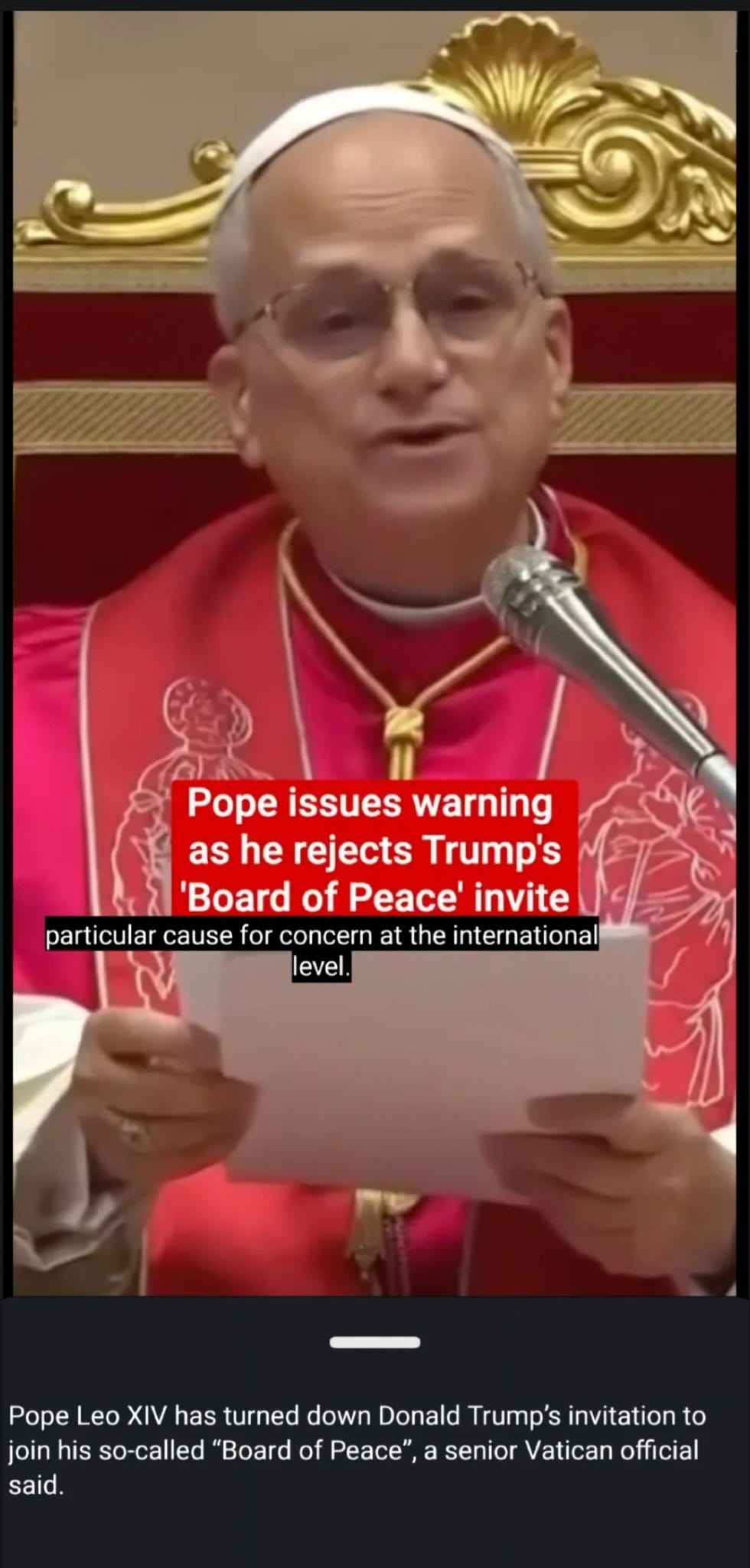
~
Amor-geddon
╯°□°)╯︵ X ┻━┻ FLIP THIS TABLE. bsky ┻━┻ ︵ ヽ(°□°ヽ) FLIP THAT TABLE. ┻━┻ ︵ tiktok \\('0')// LinkedIn/world ︵ ┻━┻ FLIP ALL TABLES Substack
ଘ(੭*ˊᵕˋ)੭* ̀ˋ ɪɴᴛᴇʀɴᴇᴛ & in person [individual/groups],. ppl
┻━┻ ︵ヽ(`Д´)ノ︵ ┻━┻
- need 100,000 signatures
#Krasnov kompromat, Putin talk Valdai International Discussion Club re: A Polycentric World: Instructions for Use", Project 2025, US Nat. Sec Policy, Trump/Orban, Trump corrupt, traitor, stone cold crazy malignant narcissist with progressing dementia, etc. etc.
F Krasnov, co. Can you help stop war criming Krasnov, Netanyahu, Putin and co. by signing/sharing this? https://change.org/ReformTheUnitedNations 100,000+ signatures needed
Foreign Assassination of Leaders, etc : Risks
https://g.co/gemini/share/6a374642f4fd
~
A Covenant Of Human Rights
~
Jeffrey Epstein explained how Donald Trump is a front for Russian money laundering..
NOBODY AS BAD AS TRUMP!! -Epstein A conversation with Journalist Zev Shalev regarding monumental complicity by MSM to hide never-ending financial crime submerged in global criminal activity
Alpha Omega of Epstein Cover-up
Jeffrey Epstein explained how Donald Trump is a front for Russian money laundering..
The day before yesterday,. Friedrich Merz, Chancellor of Germany, delivered the clearest [most watched/heard] speech in Europe in at least the last 10 years but what happened?
~
The Sovereignty Ledger: Trump's "Board of Peace" and the Liquidation of the Rules-Based Order
~
Two Paths for Global Order: Conscious Time-Binding vs. Pragmatic Shortcuts | JVS / timebinder / 1.28.2026
~
Trump’s Announcement of the Board of Peace ~ Krasnov no longer planning to take Greenland by July 4, 2026? Trump has made an offer to Greenlanders, calling it a very good offer “a very good offer.” Remember this: a deal w/ Trump [Krasnov], co. is a deal w/ the devil
https://pc93.substack.com/publish/detail/185164900?referrer=%2Fpublish%2Fposts%2Fpublished
~
US plans inaugural meeting of Trump’s ‘Board of Peace’ as questions remain over group’s mandate
https://edition.cnn.com/2026/02/07/politics/trump-board-of-peace-meeting-gaza