
Conscious Time-Binding Problem Solving
A Korzybski-Dawes Framework for Solving Problems, Improving Evaluation, and Advancing Civilization

Conscious Time-Binding Problem Solving
A Korzybski-Dawes Framework for Solving Problems, Improving Evaluation, and Advancing Civilization
| JVS / timebinder
Introduction: Humanity’s Unique Capacity
Alfred Korzybski defined humanity as the time-binding class of life.
- Plants bind chemistry through photosynthesis and metabolic assimilation.
- Animals bind space through autonomous movement and environmental adaptation.
- Humans bind time through the unique capacity to accumulate, transmit, correct, and extend knowledge across generations.
Yet time-binding occurs whether we do it consciously or unconsciously. Unconscious time-binding transmits error just as efficiently as it transmits wisdom. Civilizations preserve discoveries, but they also preserve misconceptions. They transmit scientific breakthroughs, but they also transmit dogmas, prejudices, and institutionalized inaccuracies.
Conscious time-binding begins when we deliberately assume responsibility for what we inherit, how we evaluate it, and what we pass forward. It is not merely the transmission of information. It is the ethical transmission of evaluated knowledge, corrected error, and expanded human possibilities.
Information alone can preserve folly as easily as wisdom. Conscious time-binding therefore requires both epistemological rigor and ethical responsibility.
The fundamental question becomes:
How do we use humanity’s accumulated experience to solve present problems while creating better conditions for present and future generations—achieving conscious time-binding excellence?
Rather than reacting through automatic semantic reactions, ideological rigidity, habit, or aristotelian either/or thinking, conscious time-binding engages reality through disciplined observation, multi-valued evaluation, consciousness of abstracting, consciousness of projecting, and continual self-correction.
~
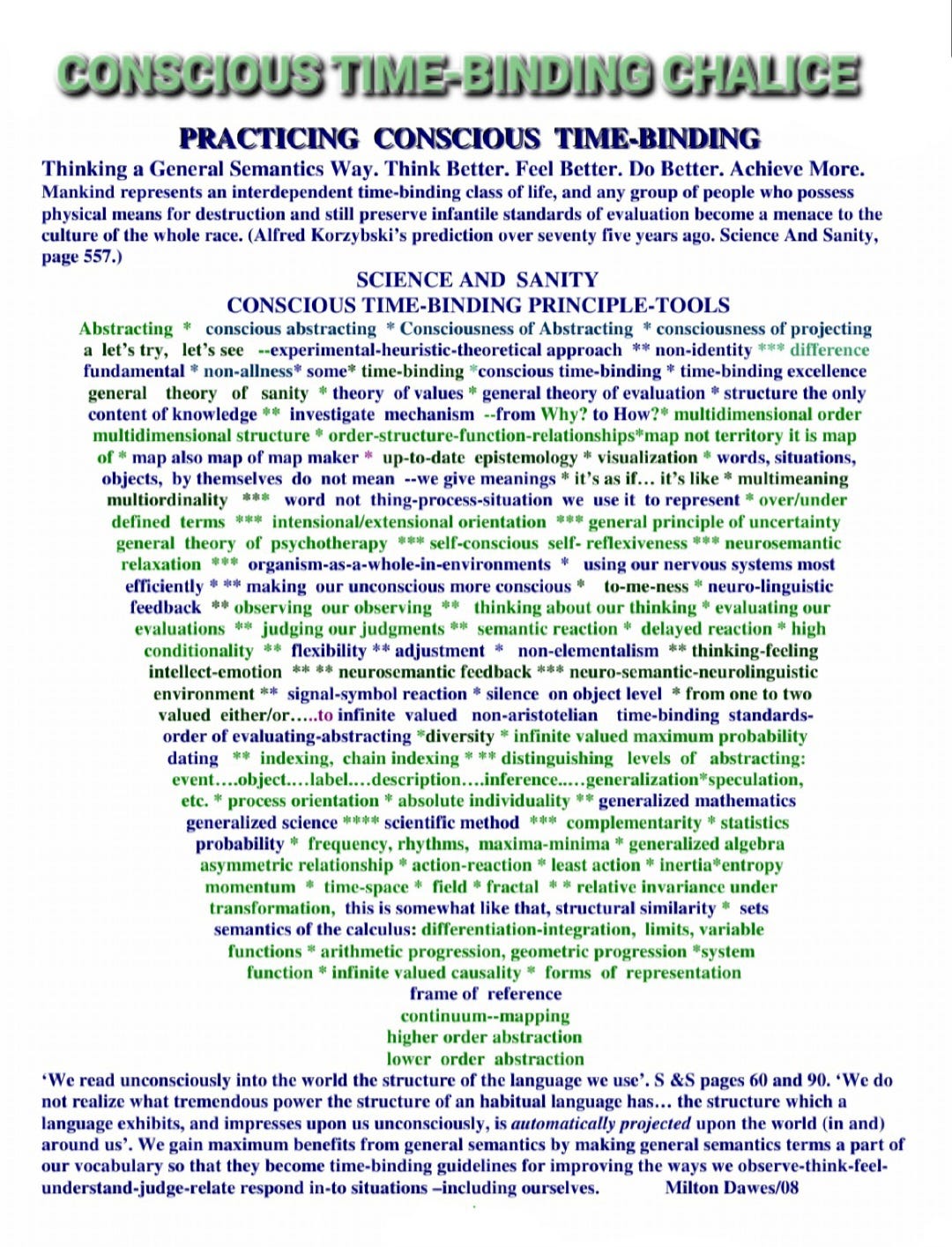
The Principle-Tools of “Chalice” of Conscious Time-Binding
Before any formula can be applied, the evaluator must cultivate the disciplines of conscious time-binding. Milton Dawes refers to these as the principle-tools of sane evaluation. While there are over 93 specific principle-tools, some of the most vital include:
- Consciousness of abstracting
- Consciousness of projecting
- Non-identity
- Non-allness (“some”, not “all”)
- Indexing and dating
- Delayed reaction
- Process orientation
- Multiordinal awareness
- Probability thinking
- Neurosemantic feedback
- Self-reflexiveness
- Observing our observing
- Evaluating our evaluations
- up-to-date epistemology
- Organism-as-a-whole-in-environments awareness
- etc. [,.] extensional orientation
These are not isolated principles, tools,. They are mutually reinforcing and serve to improve the quality of evaluation itself. Conscious time-binding ethics and excellence emerge through their continual and deliberate practice.
~
An inferred First Principle: Improve the Evaluator
Most methods focus on solving problems. General Semantics begins elsewhere: To solve structural problems, we must first improve the evaluator.
Better evaluators solve problems more effectively. Poor evaluators often create new problems while attempting to solve old ones. The primary task of conscious time-binding is therefore not changing the environment first; it is improving the fundamental quality of evaluation.
The Evaluator Equation
The baseline quality of an individual’s or group’s semantic processing is modeled as:
Q = A + CA + CP + NI + NA + MO + DR + NF
Where:
- Q = Quality of Evaluation
- A = Abstracting
- CA = Consciousness of Abstracting
- CP = Consciousness of Projecting
- NI = Non-Identity
- NA = Non-Allness
- MO = Multiordinal Awareness
- DR = Delayed Reaction
- NF = Neurosemantic Feedback
As the quality of evaluation (Q) increases, the probability of generating useful, non-delusional maps of reality also increases.
~
The Unseen Is All-Seeing
One of the central insights of General Semantics is that much of human evaluation occurs below conscious awareness. Language structures perception. Habit structures interpretation. Cultural assumptions structure expectation. Emotional conditionings structure reaction.
As Korzybski observed, we unconsciously read the structure of our language into the world around us. The task of conscious time-binding is therefore not merely to think, but to become increasingly aware of the hidden processes by which thinking itself occurs.
What remains unseen often governs what becomes visible. Hidden assumptions influence conclusions. Hidden evaluations influence decisions. Hidden structures influence institutions. Hidden language structures influence perception itself. The unseen is all-seeing because it silently shapes the maps through which we interpret territory.
Conscious time-binding seeks to bring more of this hidden process into awareness, transforming automatic reactions into deliberate evaluation.
Consciousness of Projecting (CP)
Human beings continuously project expectations, fears, hopes, desires,. and inherited linguistic structures onto external,. situations. Much of what we perceive as “out there” originates partly within ourselves. Conscious time-binding requires a continual awareness of what originates in the territory and what originates in the evaluator. The clearer this distinction becomes, the more accurate our maps become.
~
The Difference Principle
Milton Dawes frequently emphasized a simple but profound insight:
Difference is fundamental.
While similarity often attracts attention, conscious time-binding trains attention toward difference. Structural progress depends upon detecting differences that others overlook.
No two situations are ever identical. No two evaluations are ever completely identical. No two moments in history are ever completely identical. Awareness of difference protects us from false identification, semantic reactions, and premature certainty.
~
The Multi-Variate Operational and Problem Solving Formula
Once evaluation is thoroughly grounded in an up-to-date epistemology, problem-solving becomes significantly more reliable. For any complex problem, operational problem resolution (P) is an additive function of six distinct structural components in the following Problem-Solving Formula:
P = O + E + K + C + A + F
Where:
- P = Problem Resolution
- O = Observation
- E = Evaluation
- K = Knowledge Integration
- C = Coordination
- A = Action
- F = Feedback
Failure in any component weakens the integrity of the solution.
~
The Structural Protocol
Step 1: Observation (O)
Before solving, observe. Measure. Describe. Map. Systematically separate observation from interpretation. Korzybski’s foundational warning remains indispensable: “The map is not the territory.” Most human conflicts begin when descriptions become confused with reality itself.
The Reality Principle
Reality ≠ Description
The Indexing Principle
No event repeats identically.
War₁ ≠ War₂
Nation₁ ≠ Nation₂
Problem₁ ≠ Problem₂
Self₂₀₂₆ ≠ Self₂₀₂₇
History does not repeat mechanically. Structures may resemble one another, but every situation contains fundamental differences. The purpose of history is structural orientation, not blind imitation.
Operational Questions
- What actually occurred?
- What evidence exists?
- What assumptions am I adding?
- What observations support my conclusions?
~
Step 2: Evaluation (E)
Observation alone is insufficient; events must be evaluated. Reality generally appears as processes, relationships, probabilities, and degrees, defying rigid, binary aristotelian absolutism.
The Evaluation Formula
Evaluation = Context + Relationship + Process
Evaluation ≠ Static Label
Labels freeze a dynamic territory; processes evolve.
Formula for Semantic Sanity
SS = O − I
Where:
- SS = Semantic Sanity
- O = Observation
- I = Identification (the semantic error of treating the label as the thing itself)
As identification increases, flexibility decreases.
As observation increases and identification decreases, semantic sanity rises.
Multiordinal Awareness
Many conflicts emerge because people unknowingly shift between levels of abstraction while using identical words.
For example:
- Freedom₁ = Personal Autonomy (Low-order description)
- Freedom₂ = Political Liberty (Higher-order inference)
- Freedom₃ = Civilizational Capacity (High-level generalization)
Meaning changes with level of abstraction.
Meaning = Term + Context + Level of Abstraction
Operational Questions
- What relationships are operating?
- What variables interact?
- What probabilities exist?
- At what level of abstraction am I evaluating?
~
Step 3: Knowledge Integration (K)
Humanity’s greatest advantage is inherited semantic wealth.
Knowledge Formula
K = PK + PD
Where:
- PK = Past Knowledge
- PD = Present Data
Recorded and relayed experience allows previous and present generations to become active participants in present problem-solving.
Operational Questions
- Has this problem appeared before?
- What solutions succeeded?
- What solutions failed?
- What can other disciplines contribute?
~
Step 4: Coordination (C)
Many modern problems exceed individual neurological capacity. Therefore, these environments call for coordination.
Coordination Formula
C = IC × CC
Where:
- IC = Individual Competence
- CC = Collective Cooperation
If either approaches zero, effectiveness collapses. Brilliance without cooperation stagnates. Cooperation without competence becomes organized folly.
~
Step 5: Action (A)
Knowledge that remains unimplemented remains abstract, a semantic ghost.
Action Formula
A = D × E
Where:
- D = Decision
- E = Execution
Small, structurally sound actions consistently applied routinely outperform magnificent plans never executed.
~
Step 6: Feedback (F)
Every action alters the territory.
Feedback Formula
F = R − X
Where:
- R = Results
- X = Expectations
Observe outcomes. Measure divergence. Revise maps. Feedback converts error into learning. Without feedback, error becomes doctrine. Without revision, doctrine becomes dogma.
~
The Reflexive Loop & The Cumulative Spiral
Milton Dawes repeatedly emphasized self-reflexiveness. The conscious time-binder is never detached from the evaluation.
Observe the event → Observe your observation → Evaluate your evaluation → Judge your judgment → Revise your revision
Every map is not only a map of the territory. It is also a map of the map-maker. The complete process forms a recursive cycle:
Observation → Evaluation → Knowledge → Coordination → Action → Feedback → Observation..
This complete process must be visualized as a spiral, never a closed circle. A circle repeats its trajectory, duplicating old errors. A spiral accumulates. Each conscious cycle should actively generate:
- Greater accuracy
- Reduced error
- Increased adaptability
- Improved coordination
- Deeper ethical responsibility
The Dawes Principle of Spiral Advancement
Civilizations advance when learning outpaces forgetting. They decline when forgetting outpaces learning. More dangerously, civilizations decline and become endangered when structural errors become institutionalized. Ignorance can often be easily corrected through simple exposure to reality. Institutionalized error, however, actively resists correction when unchecked.
Civilizational Capability Formula
CC = (K × T) − EI
Where:
- CC = Civilizational Capability
- K = Knowledge
- T = Time-Binding Efficiency
- EI = Error Institutionalization
The true measure of advanced civilization is not raw information storage. It is the capacity to detect, correct, and replace institutionalized error.
~
The Meta-Formula for Wisdom (W)
W = O + ETB
Where:
O = Observation
ETB = Ethical Time-Binding
Ethical Time-Binding means:
- Preserving what demonstrably works
- Correcting what demonstrably fails
- Transmitting improved maps forward
- Reducing unnecessary suffering
- Expanding present and future possibilities
Knowledge without ethics magnifies potentially destructive and unchecked power. Ethics without knowledge magnifies unintended consequences. Wisdom requires the operational integration of both ethics and knowledge.
~
The Grand Conscious Time-Binding Equation
First define overall problem-solving capability:
To capture the functional human progression across generations (n), we first establish overall problem-solving capability (P) as a multiplicative product of our protocol steps:
P = O × E × K × C × A × F
We then define the overall Conscious Time-Binding (CTB) Equation as:
CTB = [(Q × P) × ETB]ⁿ
Where:
- Q = Quality of Evaluation
- P = Problem-Solving Capability
- ETB = Ethical Time-Binding
- n = Generational Iteration
Evaluation quality influences problem-solving quality. Problem-solving quality drives conscious, ethical time-binding capability. Ethical time-binding determines whether accumulated capability becomes sustained wisdom or self-destruction.
~
Time-Binding Excellence
Time-binding occurs naturally.
Conscious time-binding occurs deliberately.
Time-binding excellence occurs when individuals, institutions, and civilizations continuously improve the quality of evaluation, actions,. they transmit across time.
Excellence is not a static state of perfection. It is dynamic and strives to reduce error, advance our coordination and improve our maps of reality.
~
The Conscious Time-Binder’s Operational Grammar
Before any major decision, ask:
1. What am I assuming at the silent level?
2. What objective evidence supports this map?
3. On what level of abstraction am I operating?
4. What accumulated knowledge already exists?
5. Who must be coordinated?
6. What action will test this evaluation?
7. How will I know if I am wrong?
8. What consequences will this create for present and future generations?
These questions transform automatic reaction into conscious time-binding. They constitute the operational grammar of sanity.
~
The Time-Binder’s Axiom
Every evaluation becomes part of the future.
Every error transmitted potentially becomes a future obstacle.
Every correction transmitted, effected, becomes a future advantage.
Therefore, the highest responsibility of the time-binding class of life is the continual improvement of evaluation itself.
---
Conclusion: The Measure of a Civilization
Every generation inherits unfinished, imperfect maps. The responsibility of conscious time-binding is neither blind preservation nor reckless rejection. It is the continual refinement of humanity’s maps through disciplined observation, infinite-valued evaluation, logic,. structural correction, and ethical transmission.
We inherit the evaluations of the past. We live within their consequences in the present. We transmit and effectuate our evaluations into the future.
The future is shaped less by what we believe than by how well we evaluate, effectuate,. Conscious time-binding is the discipline of maximizing,. the quality of evaluation and effectuation.
Time-binding excellence is the successful transmission and realization of those improvements across generations.
That is conscious time-binding. That is time-binding excellence. That is the responsibility—and the profound privilege—of belonging to the time-binding class of life.
~
Hello World
Hello world

Mankind represents an interdependent time-binding class of life, and any group of people who possess physical means for destruction and still preserve infantile standards of evaluation become a menace to the culture of the whole race” - Alfred Korzybski (Science and Sanity, p. 54
~
Hold Putin/Krasnov/Bibi, war crimers accountable. 13,223 signatures reached. End P5 Veto Impunity—Protect/Serve Humanity! Together civilized humanity can make a difference.
https://change.org/ReformtheUnitedNations
~
Reconstituting the United Nations for the 21st Century: A Conscious Time-Binding Framework for Restoring Legitimacy, Upholding International Law, and Ending Impunity
https://pc93.substack.com/p/reconstituting-the-united-nations?r=55nkvn
~
Re: Special Tribunal re: war crimes
https://pc93.substack.com/p/re-special-tribunal-re-war-crimes?r=55nkvn
~
No kings, no cronies, no robber barons
A single whisper is faint, but millions banding together can roar loudly enough to topple a kakistocracy and demand The Clean New Deal, as the Dalia Lama says, “If you think you are too small to make a difference, try sleeping with a mosquito.”
A single whisper is faint, but millions banding together can roar loudly enough to topple a kakistocracy and demand The Clean New Deal

Fantastic explainer [see The Clean New Deal tutorial below] to enlighten, inspire and motivate. Let us motivate action by the millions; repost, like, reformulate if called for, spread around; not only here but can be tailored for other platforms,. and elsewhere. Copy and spread the YouTube link,.
~
Fixing Political Discourse and Politics: A Conscious Time-Binding Framework
https://pc93.substack.com/p/fixing-political-discourse-and-politics?r=55nkvn
~
The United States just refused to join a UN statement condemning russian threats to systematically strike Kyiv. Nearly 50 countries signed it. European nations signed it. Canada signed it. Japan signed it. Australia signed it. But the United States - the country that once called itself the
leader of the free world - refused to even sign a statement condemning threats against civilians in Ukraine.
~
When Russia kills Ukranian children in their sleep
~
CONSCIOUS TIME-BINDING DISPATCH | SPECIAL DISPATCH | Why Every Leader and Citizens Must Push for United Nations [UN] Reform Daily: A Conscious Time-Binding Imperative
https://pc93.substack.com/p/conscious-time-binding-dispatch-special-a9d?r=55nkvn
~
The New Untouchables Episode # 79: If you’re shocked by R’s attack of James Talarico, don’t throw stones from glass houses
https://youtu.be/F0rJ3aDOkAU?si=PNO02DrPLfWf2Nix
~
Using Korzybski’s Structural Differential: A Practical Guide to Better Thinking and Communication
https://pc93.substack.com/p/using-korzybskis-structural-differential?r=55nkvn
~
General Semantics Organizations:- Institute for General Semantics: https://generalsemantics.org
- New York Society for General Semantics: https://www.nysgs.org/